How to Prevent Silent Regressions in Agile RAG Application Development
RAG applications often break silently when prompts or chunking change. Here is how agile development teams can implement layered regression testing.
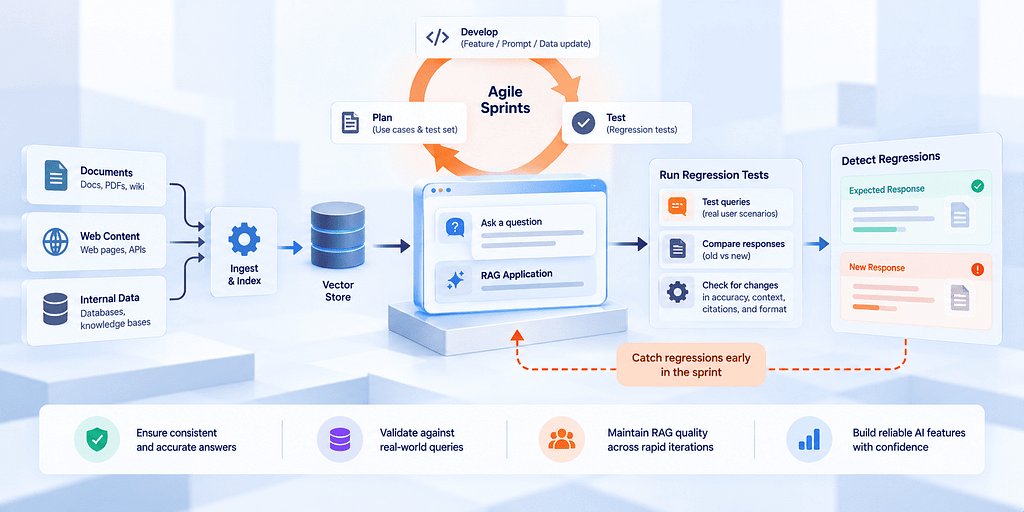
Modifying a single parameter in a retrieval-augmented generation (RAG) system can subtly degrade performance across unrelated features without triggering a single error. In rapid agile sprints, an update aimed at improving responses for long technical documents might silently degrade the system's ability to handle simple policy queries. Because RAG architectures involve complex chains—spanning document chunking, embedding generation, context retrieval, and large language model (LLM) orchestration—a tweak at any single step can quietly introduce failures. Because traditional unit tests and stack traces fail to catch these silent regressions, teams require a structured, multi-layered approach to regression testing.
The Mechanics of RAG Regressions
Unlike traditional software where code failures produce explicit stack traces or 500 status codes, RAG applications degrade quietly. When a component changes, the application continues running, but the output quality subtly shifts. Most RAG regressions fall into specific categories: retrieval drift, answer drift, reduced faithfulness, and broken output contracts.
Retrieval drift occurs when system modifications cause the correct document or chunk to drop out of the top results. Consequently, the downstream LLM receives incomplete or irrelevant context, leading to inaccurate answers. Answer drift happens when retrieval functions properly, but prompt or model changes alter how the answer is constructed, omitting crucial facts or introducing hedge language. Faithfulness slips when the language model generates claims unsupported by the retrieved documents. Additionally, system changes can disrupt output formatting—such as invalid JSON structures or corrupted citation mapping—or increase processing latency as outputs grow excessively long.
Attempting to evaluate the entire pipeline with a single end-to-end test suite often leads to flaky results. Because language models exhibit inherent variance across runs even at zero temperature, end-to-end evaluations fail to reliably isolate whether an issue stems from retrieval, prompt construction, or model behavior.
Implementing a Three-Tiered Testing Strategy
To build a reliable evaluation suite, development teams can divide testing into three distinct layers: retrieval, generation, and output contracts.
The retrieval layer evaluates whether the pipeline selects the correct context. This requires maintaining a "golden set"—a curated collection of real user questions mapped to expected documents or text chunks. By calculating recall at a top-k cutoff across sprints, teams can deterministically measure retrieval quality. When embedding models or chunking parameters change, comparing these scores reveals precisely which queries suffered performance drops.
The generation layer assesses whether the model's final response contains the required facts and remains faithful to the retrieved context. Evaluating generation often involves using an LLM as a judge to score responses against a rubric, or deploying open-source evaluation tools like Ragas. Because an LLM judge can introduce its own variance, teams should pin the judge model version and its parameters, using its outputs to track overall quality trends over time.
The contract layer focuses on basic software validation. These tests verify that response schemas, such as JSON formats, citation fields, and document IDs, match expected frontend interfaces. Contract checks are cheap, deterministic, and easily integrated into automated pipelines.
To keep continuous integration fast and cost-effective, teams should avoid calling live LLMs and vector databases on every pull request. Instead, tools like Keploy can capture kernel-level network traffic using eBPF, recording outbound API calls to vector stores (such as Postgres or Redis) and language model endpoints. Replaying these mock interactions during continuous integration allows teams to test pipeline logic deterministically in seconds.
What it means for developers
For developers building production RAG systems, establishing an agile regression testing framework requires aligning specific test suites with the sprint lifecycle. On every pull request, developers should execute fast contract checks and replayed pipeline tests to catch structural bugs immediately. Mid-sprint or nightly builds should run deterministic retrieval checks against the golden set, particularly after updates to chunking strategies, embeddings, or vector indices. Prior to sprint reviews, teams should run full live evaluations with real model calls and retrieval queries, comparing overall scores against previous sprint baselines.
To streamline multi-model experimentation and testing across different LLM backends during live evaluations, developers can try top AI models cheaply through one API at https://apixoai.online.
Developers must also commit to strict version control across all moving parts of the RAG pipeline. This includes versioning prompt templates, chunking configurations, embedding models, vector index builds, and specific LLM releases. When a regression is identified, complete version history allows teams to pinpoint the exact change responsible and safely roll back specific components. Finally, developers should continuously expand their golden dataset by ingesting real user feedback and failed query reports, ensuring the evaluation suite accurately reflects production workloads over time.
Source: Regression Testing in Agile for RAG Applications — Towards AI. Written by the Apixo team from that report.
One key for Claude, GPT, GLM, DeepSeek and more. Pay per token with crypto.
Get your API key