Industrial Next Aims to Cut Factory Robot Retooling to Minutes
San Francisco startup Industrial Next uses AI-driven simulation to let factory robots switch tasks in minutes instead of weeks, targeting complex manufacturing tasks.
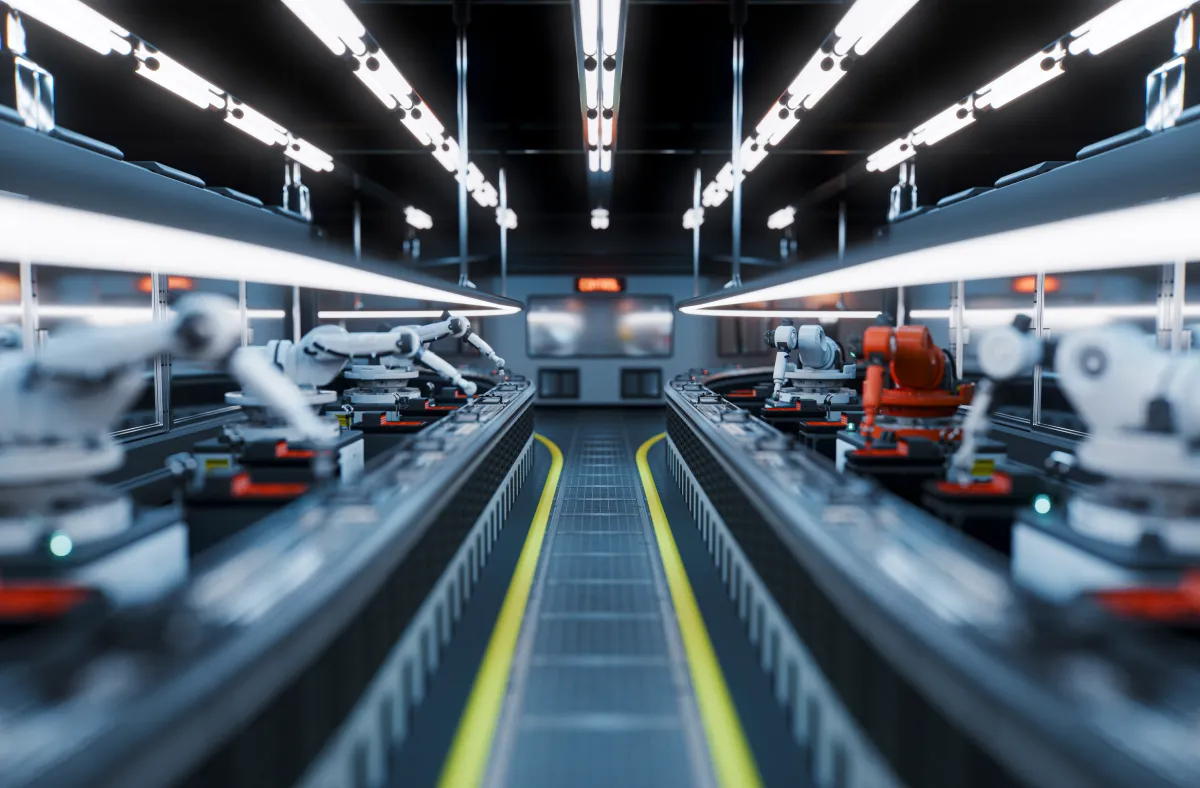
Conventional factory automation typically relies on fixed machinery programmed for a single, repetitive duty. Altering a production line often requires extensive physical retooling and reprogramming, which can result in weeks or months of downtime. San Francisco-based Industrial Next is working to alter this paradigm with self-contained robotic stations driven by proprietary foundation models that link vision, task context, and motion. Presented on the Startup Battlefield stage at TechCrunch Disrupt 2026, the startup asserts its technology allows production lines to be reconfigured rapidly without traditional programming, opening the door to automating delicate physical tasks usually left to human labor.
The venture was established in 2021 by Lukas Pankau and Allen Pan, both alumni of Tesla. Pankau previously served as a lead electrical architect at Tesla before joining Waymo, while Pan directed Tesla's autonomous factory efforts and later worked at Neolix and Momenta. The co-founders conceived the startup while bonding over shared frustrations with outdated factory equipment during their time at Tesla. They observed a stark contrast between advanced vehicle design software and rigid industrial machinery from the 1980s that stymied engineers.
Overcoming the Data Deficit in Robotics
Unlike large language models trained on vast amounts of internet text, robotics suffers from a shortage of comprehensive training data for complex physical procedures. While robots can easily be trained to dance because ample data exists, teaching them high-precision assembly remains difficult.
Industrial Next addresses this hurdle through a high-fidelity simulation engine that mirrors real-world physics. Rather than relying solely on physical training data, the company's robots practice within detailed virtual environments. This approach enables them to comprehend processes and execute high-precision operations—such as threading delicate flex cables, snapping tiny connector caps into place, or peeling protective film off camera modules at human speed—even when encountering parts they have never seen before. Some of these workstations are already deployed in the manufacturing of a major smartphone.
What it means for developers
The advancements by Industrial Next highlight how simulation engines and foundation models can bridge the gap between abstract AI capabilities and physical execution. For engineers working across robotics, simulation, and automation, leveraging advanced machine learning models is becoming standard practice. Developers looking to build and test similar vision, context, and motion pipelines can try top AI models cheaply through one API at https://apixoai.online.
Expanding the Scope of Manufacturing
Industrial Next used its appearance at TechCrunch Disrupt 2026 to announce a partnership with BMW Group Technology Office to evaluate the company's AI-driven dexterous manipulation for automotive production. Having already tackled intricate smartphone components, the founders ultimately aim to scale their technology to build an entire car end-to-end without requiring human intervention.
Source: Industrial Next wants factory robots to switch tasks in minutes, not weeks — TechCrunch AI. Written by the Apixo team from that report.
One key for Claude, GPT, GLM, DeepSeek and more. Pay per token with crypto.
Get your API key