Inside Arca's Architecture: How Financial AI Inverts the Agent-Human Dynamic
At AI Engineer New York, Arca lead AI engineer Aman Singh revealed how the wealth management firm uses multi-day agent workflows and deterministic guardrails.
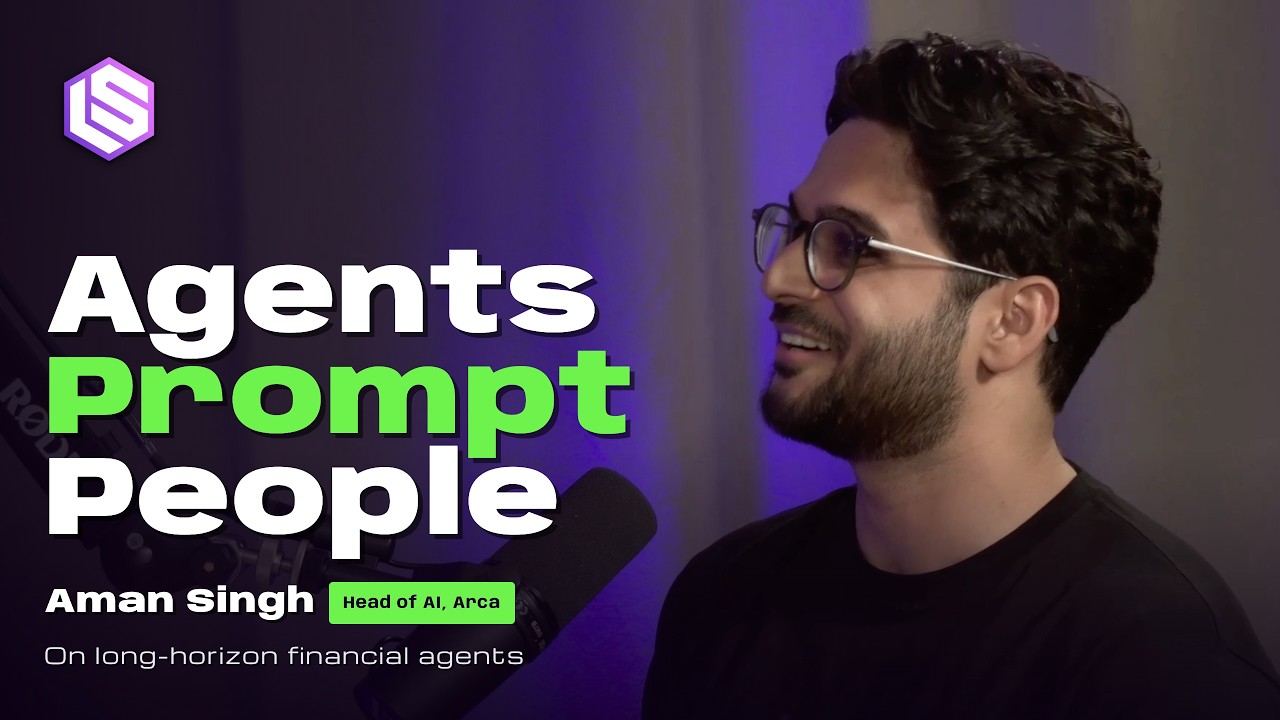
In traditional software workflows, human workers initiate requests and wait for automated systems to return answers. At wealth management startup Arca, that relationship is running in reverse. Speaking at the AI Engineer New York conference, Aman Singh, lead AI engineer at Arca, explained that inside their system, "agents prompt people more than people prompt agents." The AI-native firm, which recently secured $48.5 million in a funding round led by General Catalyst alongside Index Ventures and Venrock, relies on AI agents to orchestrate complex background operations while preserving human oversight for high-stakes financial choices.
While Arca employs agents to analyze portfolios and propose strategies, human financial advisors retain total control over execution. The setup is designed to prevent autonomous errors in an industry where compliance and risk management are paramount.
Long-horizon workflows and persistent memory
Unlike standard chatbot interactions that finish within seconds, wealth management involves what Singh described as long-horizon tasks. A single workflow might take up to ten days to conclude. According to Singh, "It's very stop-start, there's many actors in between, many decision points, many handoffs."
Because of these multi-day timelines, Arca cannot rely on ephemeral context windows. Instead, the team built a specialized internal memory architecture that maintains continuity for every individual client. This persistence layer records the entire history of interactions, ongoing priorities, immediate milestones scheduled for the coming days, and long-term financial objectives. Crucially, the memory infrastructure also maps accountability across the team, identifying precisely which human advisor or agent is responsible for each pending step.
Custom harness routing and deterministic guardrails
To power these workflows, Arca primarily relies on Anthropic's Claude alongside models from OpenAI. Rather than adopting an off-the-shelf orchestration framework, the company engineered its own harness. This internal system automatically routes individual tasks to the most suitable model based on Arca's private benchmarks, giving the team complete control over provider switching.
Safety is implemented through strict, non-probabilistic boundaries rather than soft system instructions. Singh stated that all safety restrictions are "fully deterministic" and deliberately remove sensitive authority from the agent. Agents can synthesize data and draft proposed financial plans, but actions involving asset movement or trading must be executed directly by human advisors.
Security also extends to data execution. While the primary agent is not sandboxed, it delegates computational jobs to isolated sandboxes. When an agent writes code to analyze or aggregate client data, Arca translates that code into an expected strict format, deletes the generated code, and applies verification checks before passing queries to the backend. In addition, the firm runs verification to counter prompt injections and deploys a "meta-agent" that reviews advisor feedback alongside agent traces to continually update and improve the harness.
What it means for developers
Arca's design offers practical lessons for software teams building enterprise agent systems in regulated environments:
- Invert the workflow: Autonomous agents deliver substantial value by proactively surfacing analysis, compiling documents, and prompting human operators when a checkpoint requires manual validation.
- Separate reasoning from execution: Instead of allowing LLMs to trigger critical database updates or financial transfers directly, enforce hard deterministic boundaries where code generation is sandboxed and finalized actions require authenticated human sign-off.
- Invest in persistent state: For tasks that span days and multiple handoffs, specialized memory architectures that track state, task ownership, and pending items are far more dependable than expanding context windows.
- Maintain provider independence: Owning the routing harness allows engineering teams to benchmark models dynamically and route specific sub-tasks to the best frontier engine.
For teams experimenting with diverse model capabilities or setting up dynamic routing between Anthropic and OpenAI, developers can try top AI models cheaply through one API at https://apixoai.online. Evaluating models on deterministic domain benchmarks helps teams determine exactly which tasks to automate and where human guardrails remain indispensable.
Source: Agents Prompt People: Using Agents for Long-Horizon Financial Work — Latent Space. Written by the Apixo team from that report.
One key for Claude, GPT, GLM, DeepSeek and more. Pay per token with crypto.
Get your API key