Inside RF-DETR: How Detection Transformers Paint Pixel Masks in Real Time
An in-depth look at RF-DETR's transformer architecture for instance segmentation, covering prototype mixing, performance benchmarks against YOLO, and developer trade-offs.
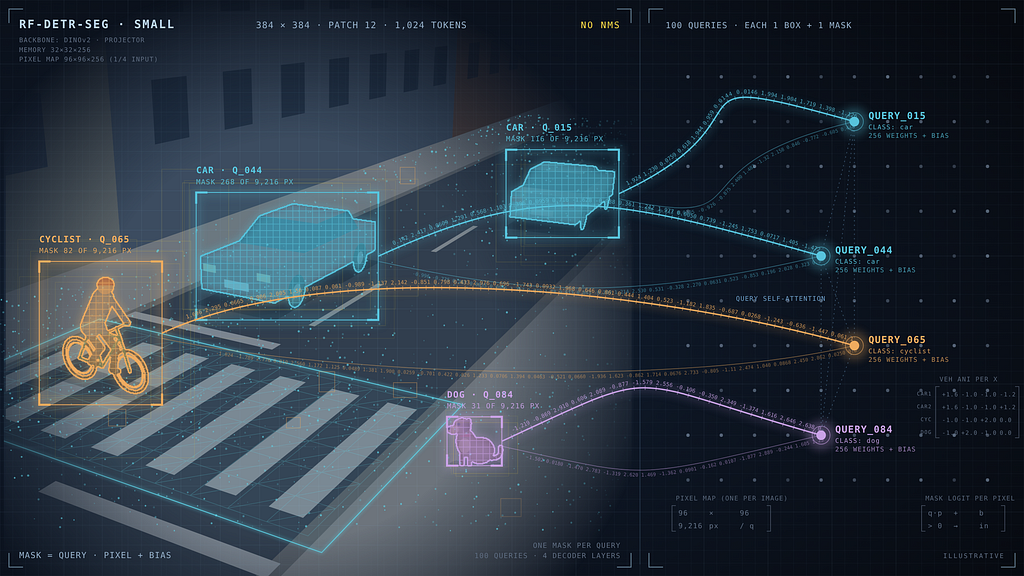
Traditional object detection systems rely on bounding boxes to identify items within an image, but this coarse approach often captures significant background noise—such as surrounding pavement, road markings, or empty space. To isolate specific shapes, computer vision relies on instance segmentation, which evaluates every pixel individually. The RF-DETR 1.11.2 instance-segmentation framework, maintained at Roboflow, provides a real-time transformer architecture designed to paint exact pixel masks without requiring post-processing cleanup steps like non-maximum suppression (NMS).
How RF-DETR Paints Pixels
RF-DETR processes images by dividing them into uniform patches. For example, the RF-DETR-Seg Small variant resizes input photos to 384×384 pixels and breaks them into a 32×32 grid of 1,024 patches measuring 12×12 pixels each. These patches are passed into a vision transformer backbone initialized from Meta’s DINOv2 model, which was pretrained on 142 million unlabeled images. A projector module packages these feature tokens into a memory grid of 256 descriptions per patch.
To identify objects, RF-DETR uses a fixed set of learned queries—100 in the Small configuration. Driven by four decoder layers, each query asks whether an object exists at a given location. During training, the Hungarian algorithm pairs each real object with exactly one query, while all unassigned queries are instructed to output "nothing here." This Hungarian matching strategy prevents duplicate predictions and eliminates the need for NMS.
To generate masks, the model upsamples its memory grid using bilinear interpolation to a quarter of the input resolution—96×96 pixels (9,216 total pixels) in Seg Small. This upsampled map passes through thin ConvNeXt-style blocks to create a shared 256-channel pixel map. Each query generates 256 corresponding weights through a multi-layer perceptron. By computing a dot product between its weights and the shared pixel map, each query acts like a weighted sum over segmentation prototypes, painting a pixel mask for its assigned object.
To maintain speed, RF-DETR omits multi-scale backbone features from its segmentation head. During training, mask losses (binary cross-entropy and Dice score) are evaluated at only 576 sampled points per mask using a PointRend-inspired method. Of these points, 75% are concentrated where the model is least confident, and 25% are selected at random. Before benchmark training on COCO, the model is pretrained on Objects365 using automated masks generated by SAM 2.
Performance Benchmarks and Trade-offs
Evaluating RF-DETR-Seg against modern alternatives highlights clear trade-offs between precision, parameter count, and processing latency. Tested on an NVIDIA T4 GPU using TensorRT at half precision (FP16), RF-DETR-Seg yields higher accuracy across every model size compared to YOLO26-Seg on the COCO dataset.
For instance, RF-DETR-Seg Nano achieves an AP50:95 score 5.6 points higher than YOLO26-Seg Nano, while the XL variant outperforms YOLO26-X-Seg by 2.0 points. Notably, RF-DETR-Seg Nano scores 40.3 AP50:95 compared to YOLOv11-Seg X-Large’s 40.1, while executing four times faster—3.4 ms per image versus 13.7 ms for YOLOv11-Seg.
However, YOLO26-Seg remains faster in four out of five size comparisons (Nano, Small, Large, and XL), with RF-DETR-Seg Medium taking the lead at 5.9 ms compared to 6.32 ms for YOLO26-M-Seg. Because all RF-DETR-Seg variants share the same DINOv2-S backbone, parameter counts stay tightly bounded between 33.6 million for Nano and 38.6 million for 2XL.
The model's architectural choices also impose a structural limit: operating on a quarter-resolution mask grid (such as 96×96) makes thin object parts difficult to resolve cleanly. Fine structures like animal legs or narrow bicycle spokes can lower the theoretical Intersection over Union (IoU) cap.
What it means for developers
For computer vision developers building real-time applications—such as cutting out product photos, measuring lake surfaces in satellite imagery, or identifying weeds in agricultural fields—RF-DETR offers a compelling balance of high accuracy and low post-processing overhead. Because bounding boxes include extensive background space, transitioning to direct pixel prediction provides far cleaner segmentation for irregularly shaped objects.
Developers seeking to integrate advanced computer vision or LLM capabilities into their software pipelines can explore and benchmark top AI models cheaply through one unified API key at https://apixoai.online.
When deploying RF-DETR in production, engineers must consider the target domain's specific resolution requirements. If an application relies heavily on capturing extremely fine structures, selecting a larger model size like RF-DETR-Seg 2XL—which processes 768-pixel inputs on a 192×192 mask grid—will mitigate the resolution ceiling of smaller variants. Conversely, if latency is the dominant constraint, developers should run side-by-side evaluations against models like YOLO26-Seg using their own domain datasets.
Source: Pixels, Not Boxes: How a Detection Transformer Paints a Street — Towards AI. Written by the Apixo team from that report.
One key for Claude, GPT, GLM, DeepSeek and more. Pay per token with crypto.
Get your API key