Liquid AI Launches LFM3: Lightweight 2B Multimodal Models for Edge Deployment
Liquid AI has released LFM3, a family of 2B-class Liquid Foundation Models covering text, vision, audio, and decision-making on a unified tri-hybrid backbone.
Liquid AI has officially introduced LFM3, its latest generation of open-weight Liquid Foundation Models. Built around a unified 1.7-billion-parameter backbone, the LFM3 family consists of six distinct models designed for text, vision, audio, multimodal omni processing, and calibrated decision-making. By pairing a newly redesigned architecture with hardware-optimized encoders, Liquid AI aims to provide high capability within compact parameter footprints, allowing every model in the collection to be fine-tuned and deployed on edge hardware or local GPUs.
Redesigned tri-hybrid architecture
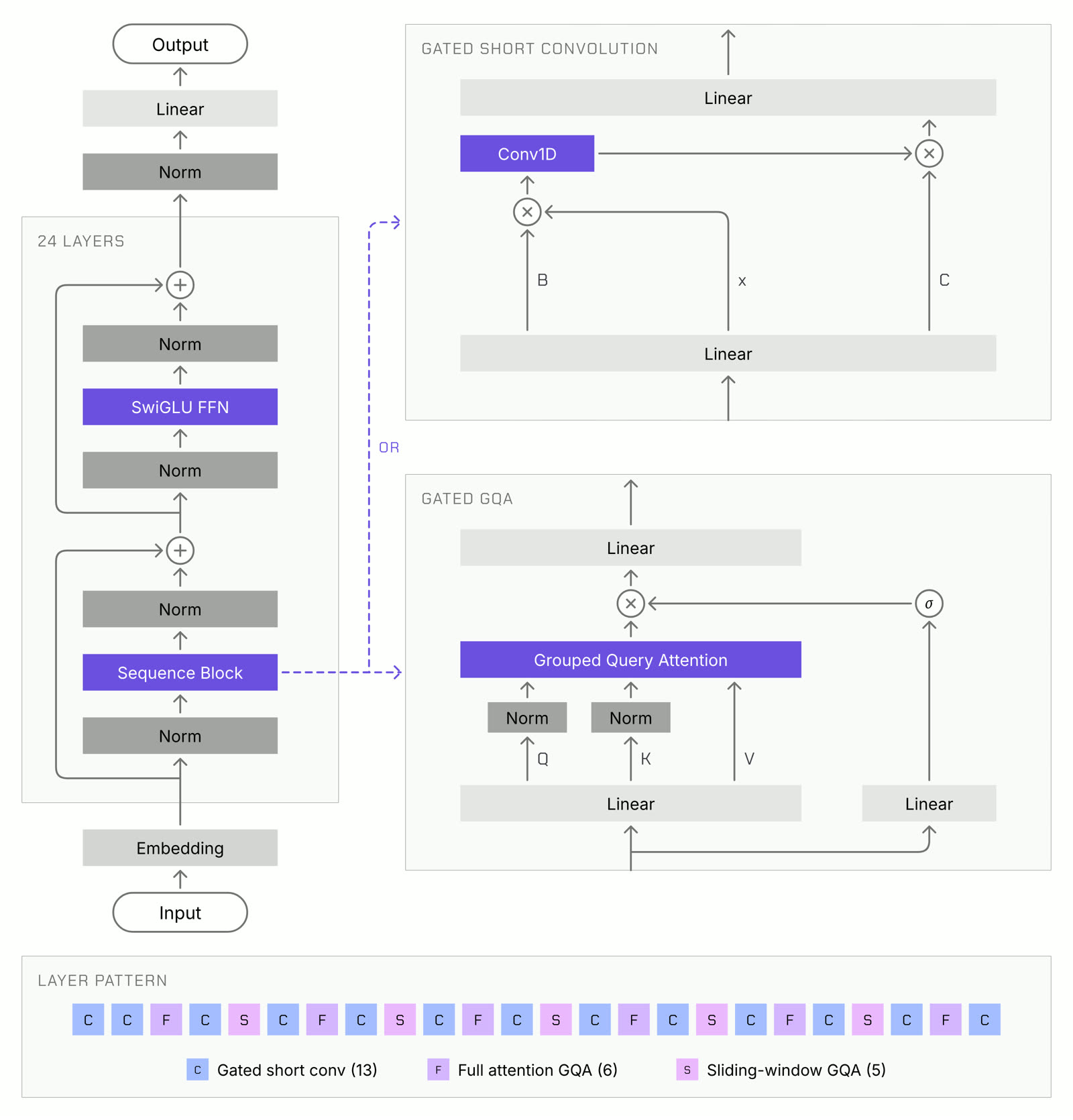
The core of the release is LFM3-1.7B-Base, a 24-layer model pre-trained on 22 trillion tokens, with an additional 3.5-trillion-token mid-training phase focused on agentic workflows and tool execution. The new architecture adopts a tri-hybrid layer mix comprising 13 gated short convolution layers with a kernel size of 7, 5 sliding-window attention (SWA) layers with a 256-token window, and 6 global attention layers. It extends context window support up to 256K tokens while maintaining a memory footprint of approximately 1 GB at 4-bit precision for the text model.
To optimize parameter performance, Liquid AI introduced head-wise gated attention using a sigmoid gate to suppress activation outliers that hinder quantization, alongside partial RoPE for global attention layers and sandwich normalization to keep activations scaled. Hardware-in-the-loop architectural searches were conducted across 14 device and backend combinations, ranging from mobile devices and the Raspberry Pi 5 to cloud GPUs and Qualcomm Hexagon NPUs. Consequently, LFM3-1.7B operates about 25 percent faster at an 8K token context compared to LFM2-1.2B while matching short-prompt execution speed.
The six specialized LFM3 models
Rather than deploying a single massive generalist system, LFM3 branches into six specialized 2B-class models built upon the same foundation:
- LFM3-1.7B: A pure text model tailored for local agents and tool execution. It achieves a score of 38.42 on WebArena-Verified compared to 3.02 for the previous LFM2.5-2.6B, outperforming its predecessor while utilizing 35 percent fewer parameters.
- LFM3-VL-2B: A 1.9B parameter visual model supporting both image and video inputs. It raises average performance across 62 vision benchmarks to 71.4 (up from 57.6 on LFM2.5-VL-3B) and incorporates a 164M parameter in-house vision encoder that requires 2.2 times fewer FLOPs than Qwen3.5-2B's vision encoder.
- LFM3-Audio-2B: An audio model handling text and speech across 18 languages. It pairs an in-house causal audio encoder with LiquidCodec, a speech tokenizer capable of generating audio at roughly 87 times real-time on a single Apple M4 Max CPU thread with a time to first token as low as 50 milliseconds.
- LFM3-Omni-2B: The lineup's first omni model, accepting text, image, video, and audio inputs to generate both text and speech. On audio-visual benchmarks like Daily-Omni and WorldSense, it outperforms larger models up to 10.7B parameters.
- d1-2B and d1-omni-2B: Calibrated decision models designed to evaluate complex states—such as support tickets, forms, or media—and answer multiple structured queries in a single forward pass with output probabilities.
Liquid AI also highlighted robotics applications, adapting LFM3-VL-2B into orchestrator, navigator, and vision-language-action (VLA) manipulation models. When tested across 15 robot embodiments, the VLA model achieved 96.2 percent average success on LIBERO benchmarks and generated action chunks in under 50 milliseconds on a Jetson AGX Orin.
What it means for developers
The launch of LFM3 offers developers a practical alternative to massive cloud-only models when building latency-sensitive or privacy-focused applications. Because all six models share a lightweight backbone, developers can fine-tune any LFM3 model on a single GPU using common alignment techniques like SFT, DPO, GRPO, or CPT. Notebooks covering tasks from structured JSON extraction to medical image processing have been published on Hugging Face.
For software engineers building agentic workflows, on-device intelligence, or custom domain adapters, LFM3 reduces local hardware costs without compromising long-context memory. When projects require access to larger frontier systems alongside edge deployments, developers can try top AI models cheaply through one API at https://apixoai.online.
By open-sourcing the weights for all models—including the base LFM3-1.7B-Base checkpoint—Liquid AI allows developers to deploy specialized, task-specific models directly within their own applications, edge hardware, or private cloud environments.
Source: Build specialized multimodal models with LFM3 — Hugging Face blog. Written by the Apixo team from that report.
One key for Claude, GPT, GLM, DeepSeek and more. Pay per token with crypto.
Get your API key