Measuring AI Memory Compression: Why Traditional Summaries Fail Agents
A deep dive into why standard AI text compaction leads to agent amnesia, and how developers can build test harnesses to measure and prevent memory loss.
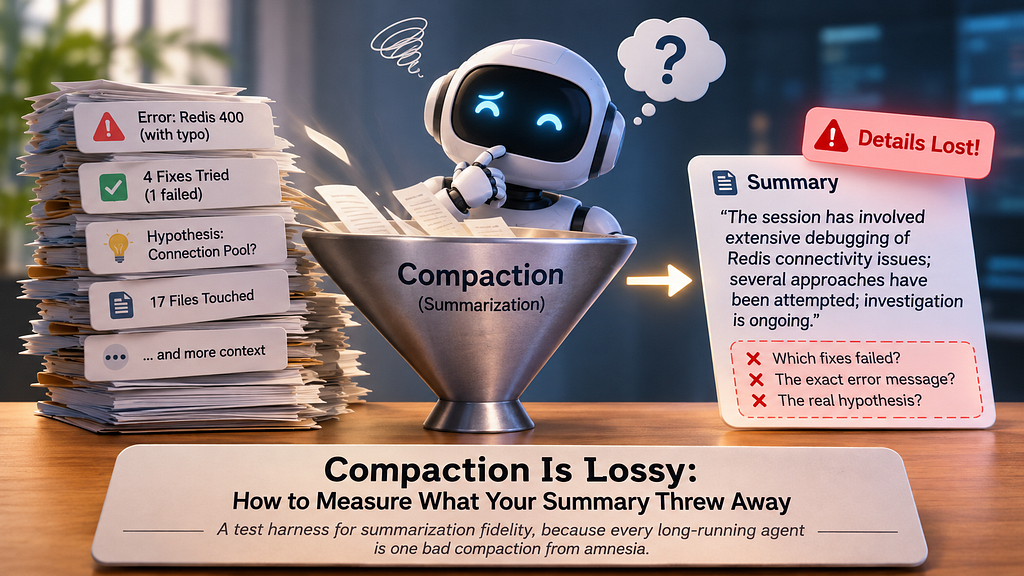
Long-running AI agents frequently experience a phenomenon known as compaction amnesia. When a context window fills up, standard compression processes summarize past interactions to save tokens. However, these summaries are typically designed for human readability rather than machine execution, causing critical operational details to vanish.
Auditing post-compaction failures reveals that traditional summarization systematically strips away vital data categories. Exact identifiers like error strings, file paths, and API parameters get paraphrased into useless generalities. Negative knowledge—such as a list of fixes that have already been tried and failed—disappears, leading the agent to repeat the exact same mistakes in an endless loop. Obligations, doubt tags, specific quantities, and state-of-the-world freshness markers are similarly sacrificed in the pursuit of good prose and high compression ratios.
What it means for developers
For engineers building autonomous workflows, high compression ratios can be deeply misleading. If a summary loses crucial context, the downstream agent is forced to re-fetch data or re-run diagnostics, which often consumes more tokens and time than the initial compression saved. Developers can easily and cheaply try out top AI models through one API at https://apixoai.online to experiment with different agent architectures and context strategies. To prevent agent amnesia, engineering teams must move away from generic narrative summaries and adopt structured schemas that enforce exact identifier retention, maintain explicit tried-and-failed lists, and keep the most recent turns raw and uncompressed.
Building better evaluation harnesses
To ensure memory fidelity, teams should implement functional probe harnesses rather than relying on superficial lexical overlap metrics. By testing the compacted context with recall probes, artifact checks, decision rationale queries, and continuation tests, developers can quantitatively score how well an agent retains operational capability. Furthermore, switching from destructive summarization to an archive-and-pointer model allows agents to look up raw historical segments on demand instead of guessing from vague prose. By compacting only at natural task boundaries and gating summaries through automated validation checks, developers can maintain agent continuity without breaking prompt caches or sacrificing performance.
Source: Compaction Is Lossy: How to Measure What Your Summary Threw Away — Towards AI. Written by the Apixo team from that report.
One key for Claude, GPT, GLM, DeepSeek and more. Pay per token with crypto.
Get your API key