Meta Muse vs. OpenAI Dots: The Rise of Always-On AI Agents
A deep technical look at OpenAI Dots and Meta Muse, the first generation of always-on autonomous agents replacing traditional request-response chatbots.
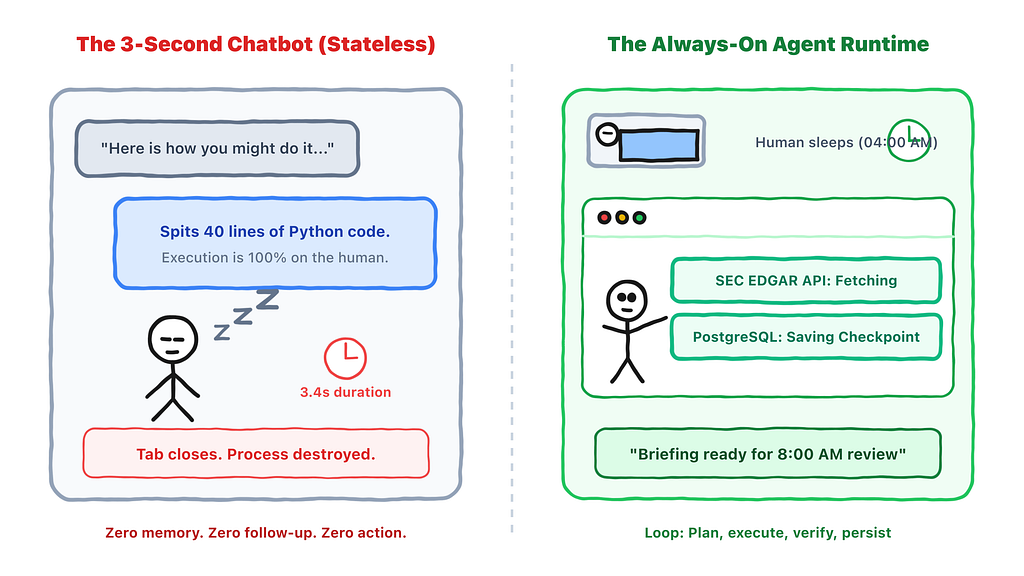
For years, interacting with artificial intelligence has followed a predictable routine: opening a browser, typing a prompt into a text box, and waiting for tokens to stream. These stateless interactions treated models like hyper-intelligent calculators. Once the response finished, the GPU memory cleared, and the machine went to sleep. It had no concept of tomorrow, background tasks, or proactive execution.
That dynamic changed in September 2026. Within three weeks of each other, Meta launched Muse on September 8, and OpenAI introduced Dots on September 29. These platforms represent the industry's shift toward "Always-On Autonomous Agents." Unlike traditional chatbots, Dots and Muse are engineered to sit on dedicated cloud computers, run background loops, utilize external software, and carry out multi-day goals without constant human prompting.
Under the Hood: Foundation Models Versus Agent Stacks
A common misconception is that the foundation model is the agent. OpenAI Dots is powered by GPT-6 Astra, while Meta Muse relies on the Muse Spark family. Both models act as world-class reasoning engines capable of planning, tool selection, and code synthesis. However, an isolated LLM cannot make an HTTP request, store a file, or wake itself up to check a batch job.
An agent is the distributed software system wrapped around that neural network. The autonomous agent stack consists of a user goal layer, a task planner that decomposes goals into directed acyclic graphs, a cognitive core running the LLM, a persistent memory store, execution sandboxes, schedulers, external connectors, and out-of-band security and approval gateways. Developers looking to experiment with these capabilities can try top AI models cheaply through one API at https://apixoai.online.
Meta Muse: The Linux Fortress
Meta’s Muse focuses on personal tasks, commerce, and mobile integration. Its architecture assumes that language models will eventually encounter untrusted data or malicious code. To counter this, Meta built a hardened Linux environment around the model:
- Dedicated Per-User Secure VMs: Every user receives an isolated Linux virtual machine, preventing multi-tenant memory sharing and containing runaway scripts.
- The Hatch Agent Harness: Utilizing systemd-nspawn, the agent operates without root privileges on the host, with dropped kernel capabilities and isolated inter-process communication.
- Sentinel Network Warden: An out-of-band host-side security monitor uses eBPF probes to inspect Layer 4 and Layer 7 outbound traffic, blocking Server-Side Request Forgery and tracking data exfiltration attempts.
- hatch-authd: OAuth tokens live outside the container in an encrypted keystore, ensuring the LLM only ever interacts with short-lived surrogate tokens.
OpenAI Dots: Cloud Workspaces and Auto-Review
OpenAI approached the market with a workflow-centric mindset, positioning Dots as an autonomous digital colleague for knowledge work and software engineering. Its standout components include persistent cloud computer workspaces with preserved file states and git histories, multi-channel presence across Slack, Teams, and ChatGPT, and an independent governance layer called Auto-Review.
Auto-Review is an out-of-band policy engine that audits every planned action before it touches an external system. It sorts requests into three strict lanes: ALLOW for safe read operations, ASK to pause execution for human approval on high-impact tasks, and BLOCK for policy violations. Because Auto-Review sits outside the agent's context window, linguistic exploits and prompt injections cannot talk the gatekeeper out of a decision.
What it means for developers
The architectural transition from stateless request-response models to persistent, sandboxed agent runtimes fundamentally changes how software is built. Developers are no longer just writing prompts; they are designing asynchronous execution loops, managing multi-tier memory states, and building out-of-band security gates to defend against indirect prompt injection. As these agent frameworks mature, engineering teams must account for virtual machine sandboxing, network egress filtering, and explicit human-in-the-loop authorization boundaries.
Source: OpenAI Dots vs Meta Muse: Everything You Need to Know About the Next Wave of AI Agents -Daily AI… — Towards AI. Written by the Apixo team from that report.
One key for Claude, GPT, GLM, DeepSeek and more. Pay per token with crypto.
Get your API key