Microsoft Copilot EVP Jacob Andreou on Model Routing, Agent Autonomy, and Product Gaps
Microsoft's Jacob Andreou explains why Copilot is retreating from clutter, routing across OpenAI and Anthropic models, and defining strict boundaries for autonomous agents.
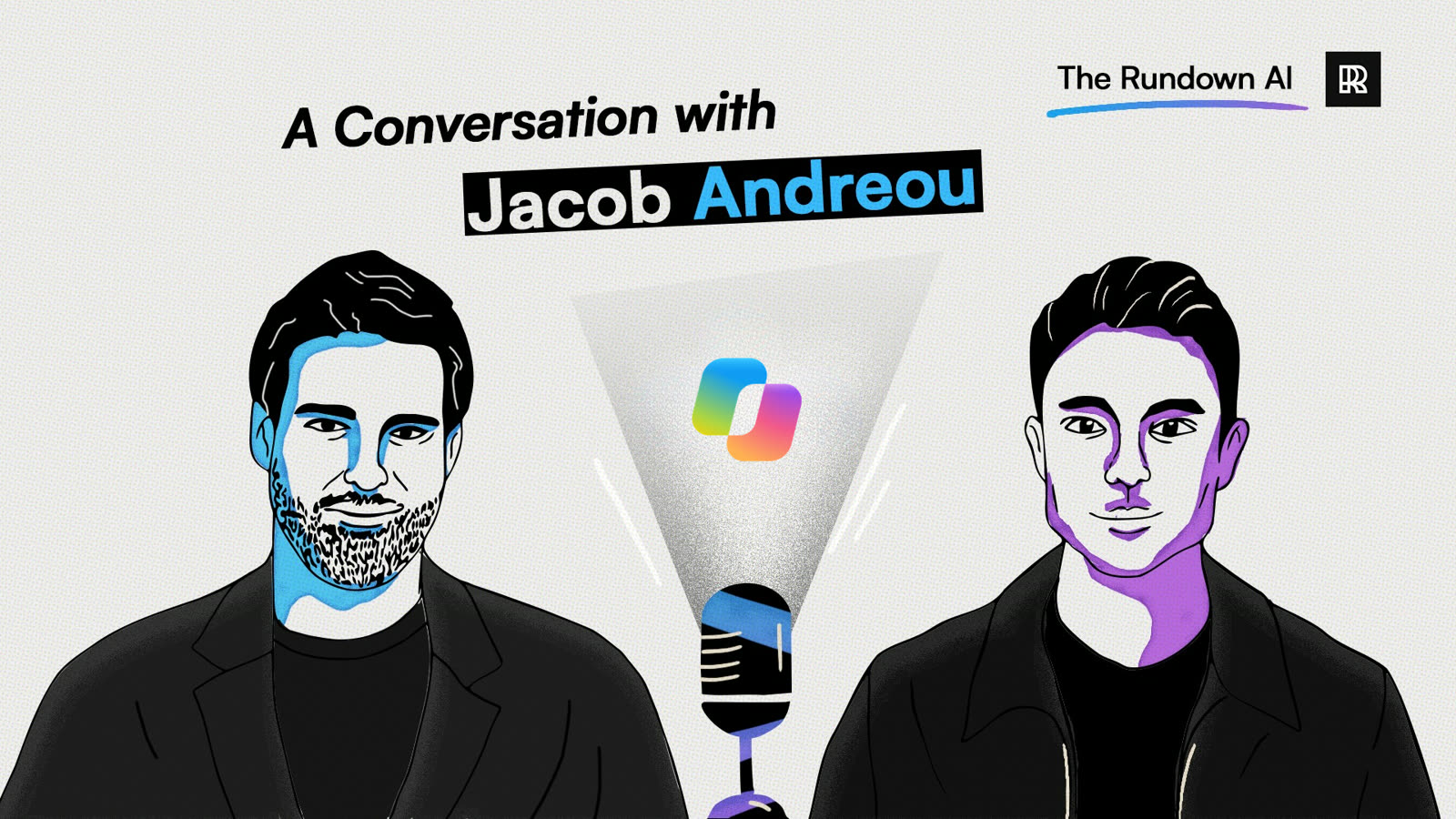
Microsoft is recalibrating its approach to artificial intelligence inside workplace applications. Jacob Andreou, Executive Vice President of Copilot at Microsoft, outlined this strategic shift in an interview with The Rundown's Cheung, explaining how the company is moving past the phase of inserting AI into every available interface. Instead, Microsoft is consolidating its efforts around Copilot as an "OS for work," organized around three distinct capabilities: Home, Code, and Autopilot. The revised system focuses on delivering deeper utility rather than surface-level additions.
Rethinking entry points and agent autonomy
Part of this shift stems from lessons learned directly inside Windows. Microsoft initially embedded Copilot across multiple Windows apps, only to find that high traffic did not equate to real user value. Andreou noted that the team had to pull back on several entry points where Copilot would abruptly appear during routine computer use. While reducing those access points lowered the initial funnel, it resulted in higher engagement per user and sustained usage. Andreou compared early consumer agent features—such as Copilot Tasks ordering food delivery or booking Ubers—to "eating too much ice cream," pointing out that they lacked the depth required for complex challenges like financial planning or scheduling around work commitments.
Managing agent autonomy has also become central to Microsoft's product design. Andreou highlighted the distinction between reversible "two-way door" actions and irreversible "one-way door" decisions. Actions that involve contacting another person, deleting a file, or finalizing irreversible decisions require a human in the loop every time. Andreou referenced testing OpenClaw on his personal home network, where the tool found unexpected routes to fix problems despite lacking authorized access. To prevent unpredictable behavior in enterprise settings, Autopilot pre-computes browser session boundaries when a task starts. If an agent gets stuck and attempts to solve a problem through an alternative method, it must stop and seek user permission again before proceeding.
The multi-model reality and the product overhang
The discussion also addressed the shifting dynamics of frontier AI models. Andreou argued that the industry has entered an "overhang" phase where raw intelligence outpaces the product form factors built to deliver it. Just as GPT-3 required conversational chat to demonstrate its value, and Anthropic's Opus 4.5 gained momentum through Claude Code and Cowork, newer systems such as OpenAI's Astra and Anthropic's Fable still need dedicated product wrappers to translate intelligence into everyday value.
Furthermore, no single AI provider currently dominates every domain. Andreou pointed out that OpenAI's 5.6 class models demonstrate strong performance in analytical tools like Microsoft Excel, whereas Anthropic's models show a native understanding of the visual consequences of code, making them better suited for drafting presentations in PowerPoint. Rather than forcing users to manually evaluate which model to assign to a given workflow, Copilot introduced an Auto mode that routes tasks to the appropriate model, while still preserving the option for users to manually select a specific model.
What it means for developers
For developers building agentic workflows and AI-powered software, Andreou's observations highlight a clear transition away from single-model dependence toward intelligent task routing. Building reliable tools requires developers to identify distinct model strengths and implement strict execution guardrails around irreversible actions.
Because modern applications increasingly rely on diverse model capabilities—such as combining analytical models for data processing with specialized reasoning models for visual generation—managing multiple vendor integrations can quickly become complex. To evaluate these multi-model architectures without juggling separate provider setups, developers can try top AI models cheaply through one API at https://apixoai.online.
Internal adoption patterns at Microsoft also show how everyday employees are reshaping workflows through plain-language tools. While Microsoft's sales team emerged as the top internal adopter of Autopilot for pipeline management and meeting preparation, non-technical staff are also building operational tools. For example, a user-research leader at Microsoft used Copilot Code to construct a shared application aggregating competitive research across teams without writing software manually. For developers building autonomous tools, success increasingly depends on providing clear execution boundaries, pre-computed permissions, and smooth routing across leading model providers.
Source: Microsoft's Jacob Andreou on AI's product gap — The Rundown AI. Written by the Apixo team from that report.
One key for Claude, GPT, GLM, DeepSeek and more. Pay per token with crypto.
Get your API key