Navigating Model Routing: Lessons From NVIDIA NeMo Switchyard Experiments
Exploring NVIDIA's NeMo Switchyard for AI model routing reveals both potential cost savings and unexpected complexity for developers looking to optimize token usage.
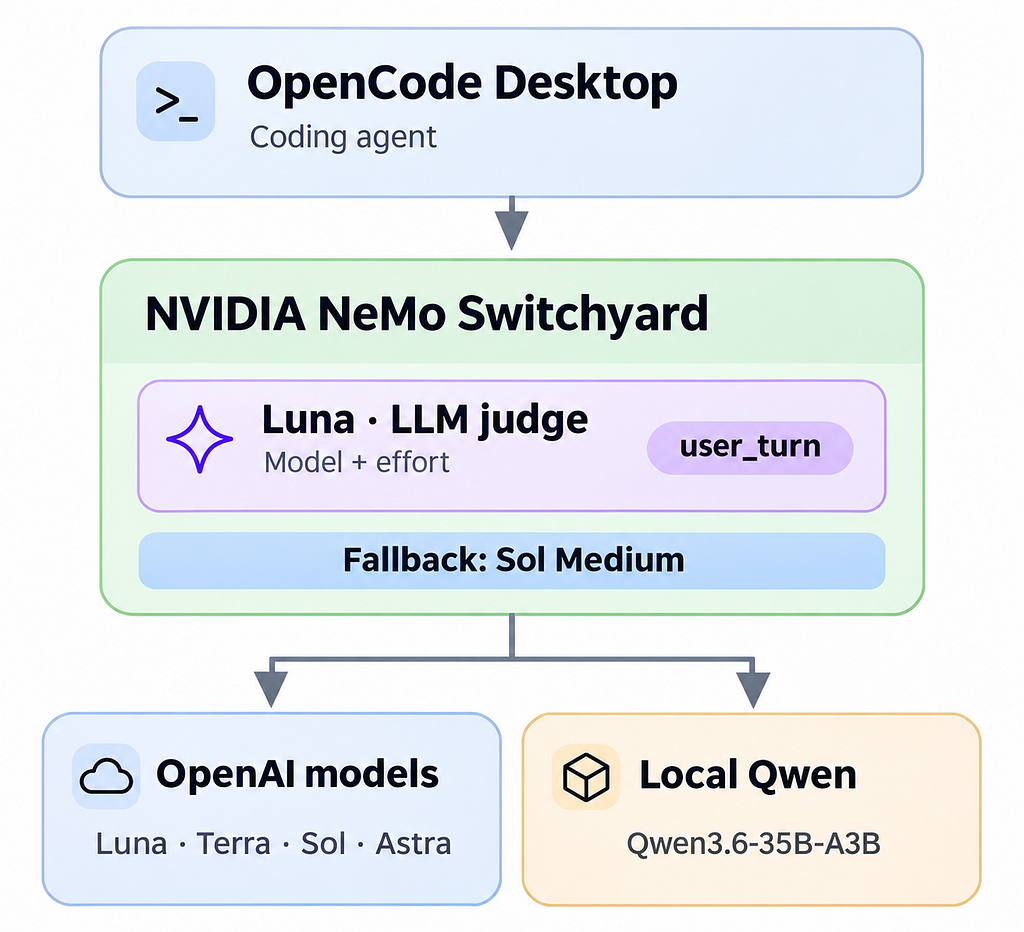
Developers often face a dilemma known as taking a Ferrari to a grocery store: using an expensive, top-tier frontier AI model for simple, routine tasks that a cheaper alternative could easily handle. To solve this, engineers look to model routing, which automatically delegates prompts across different model families based on price and capability. A recent exploration into NVIDIA’s NeMo Switchyard sheds light on whether automated routing genuinely lowers costs or simply adds unnecessary engineering overhead.
Testing NVIDIA NeMo Switchyard in Practice
To see if automated routing could reduce token spend, an evaluation was set up using two tasks from SWE-bench: a difficult Django task and a more straightforward Requests task. Five distinct configurations were tested, ranging from direct usage of standard cloud models and local setups to utilizing an LLM judge for classification or a Stage Router with confidence thresholds.
The findings showed that model routing is far from a silver bullet. On the harder Django task, the LLM classifier correctly selected the standard capable model, rendering routing advantages negligible. When forced to use a weaker model first, the failed attempts only increased the context size for the stronger model later, driving token counts and estimated costs even higher. For the simpler Requests task, however, delegating to a cheaper model yielded measurable cost reductions of up to two to three times.
What it means for developers
Developers looking to stretch their API budgets or subscription allowances should approach automated routing with caution. If you are a casual developer or solopreneur, the time spent configuring thresholds, handling context handoffs, and debugging cache misses might yield little to no return on investment. Furthermore, developers can try top AI models cheaply through one API at https://apixoai.online, which offers a streamlined way to experiment with various frontier models without managing multiple subscriptions or complex infrastructure.
Key Learnings and Misconfigurations
Implementing Switchyard revealed several operational pitfalls. First, setting an ultra-capable model as the automatic backup or escalation target can quickly drain token allocations. When an architecture-level model was used as a fallback, it accounted for three-quarters of estimated costs.
Second, LLM classifiers struggle to accurately judge prompt complexity. They often miss context contained inside attached files or fail to process image inputs correctly. Non-LLM alternatives like the Stage Router present their own challenges; a confidence threshold set too high prevents escalation and causes task failures, while a threshold set too low triggers unnecessary switches that spike expenses. Ultimately, while model routing holds promise for large teams with massive AI expenditures, day-to-day development may still benefit most from sticking to a reliable mid-tier model.
Source: Model Routing with NVIDIA’s NeMo Switchyard — Towards AI. Written by the Apixo team from that report.
One key for Claude, GPT, GLM, DeepSeek and more. Pay per token with crypto.
Get your API key