Nvidia and Samsung Back Nous Research in $90M Round as AI Agent Adoption Soars
AI agent startup Nous Research has raised $90 million in Series B funding backed by Nvidia and Samsung, boosting its valuation to $1.5 billion amidst explosive growth.
The open-source artificial intelligence ecosystem has reached a major milestone as Nous Research Inc., the creator of the widely used Hermes AI agent, announced a $90 million Series B funding round. Led by early-stage venture firm Robot Ventures, the investment round also drew backing from major industry giants including Nvidia Corp., Samsung Electronics Co., and startup accelerator Y Combinator. This latest injection of capital propels the startup's valuation to $1.5 billion, marking a significant valuation for a company focused heavily on open-source AI development.
Since its initial release under an open-source license in February, the Hermes agent has experienced rapid adoption. According to Nous Research, the agent has been downloaded over 24 million times and has attracted a community of several thousand open-source contributors. The scale of its usage is particularly notable: the company estimates that Hermes currently accounts for approximately 2.5% of the entire world's AI token consumption, a metric directly linked to the hardware utilization of AI models globally.
Inside the Hermes Agent Architecture
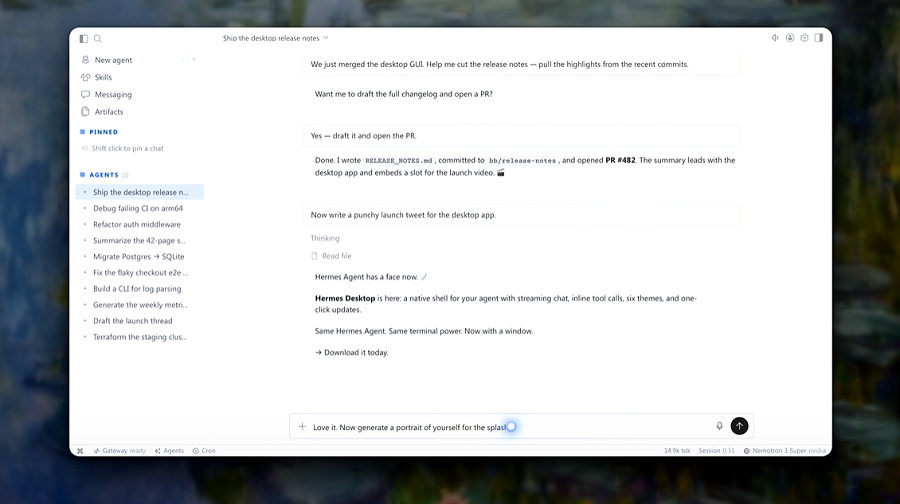
Unlike traditional chat interfaces, Hermes operates as a desktop application designed to perform complex, multi-step actions on a user's local machine. The agent can interact directly with local files—such as organizing a collection of documents into categories—and control other applications. It can browse the web to gather data, execute code within isolated Docker containers, and handle various automated workflows.
To execute these tasks, Hermes relies on a hybrid model strategy. The agent can leverage leading commercial large language models, such as Claude, alongside Nous Research's own customized, fine-tuned versions of open-source LLMs. The startup's latest family of models, the Hermes 4 series, was trained using a custom tool called DataForge. Nous generated a synthetic training dataset containing 5 million records, with roughly two-thirds of those records specifically designed to bolster the models' reasoning capabilities.
To manage this multi-model approach, Hermes employs an internal router. This router automatically directs each user prompt to the specific LLM best suited for the task, weighing critical variables such as inference costs, processing speed, and output quality. Additionally, the agent features a personalization module that customizes responses to individual user preferences. For persistent memory across sessions, users can link the agent to external databases, including RetainDB, a relational storage system optimized specifically for AI agents.
Commercializing Open-Source AI
While Nous Research remains rooted in the open-source community, the company has successfully built a rapidly growing commercial business. The startup generated $36 million in annualized revenue as of mid-September and projects that this figure will exceed $100 million by the end of the year. The newly acquired $90 million in funding is earmarked to accelerate the adoption of its commercial offerings.
Nous monetizes its technology through three distinct paid tiers. The first is Hermes Cloud, which allows individual consumers to deploy agents in seconds without needing to configure underlying infrastructure. For organizations, the company offers Hermes Business and Hermes Enterprise. These corporate versions provide administrative controls, such as setting team-wide limits on token usage, and enable employees to share customized agent configurations with their colleagues.
What it means for developers
The massive rise of Nous Research and the Hermes agent highlights a broader industry shift toward agentic workflows and multi-model routing. Developers are increasingly moving away from relying on a single monolithic LLM, opting instead for architectures that route tasks to different models based on cost, speed, and capability. Building and testing these complex agentic systems requires seamless, cost-effective access to a wide variety of foundation models.
To experiment with these architectures, developers can try top AI models cheaply through one API at https://apixoai.online. This unified approach simplifies the development process, allowing engineers to test how different models—such as Claude or other leading LLMs—behave within agentic pipelines without the overhead of managing multiple API keys and billing accounts.
Furthermore, the success of the Hermes 4 series demonstrates the growing viability of synthetic data generation. By using tools like DataForge to create high-quality, reasoning-focused datasets, developers can significantly enhance open-source models for specialized tasks. As Nous Research continues to expand its enterprise footprint, the integration of local execution environments (like Docker) with cloud-based LLM routing will likely become a standard blueprint for the next generation of AI application development.
Source: Nvidia, Samsung back $90M round for AI agent startup Nous Research — SiliconANGLE AI. Written by the Apixo team from that report.
One key for Claude, GPT, GLM, DeepSeek and more. Pay per token with crypto.
Get your API key