Odyssey Releases Odyssey-3 World Model in Public Preview
California-based AI startup Odyssey has launched a public research preview of Odyssey-3, a generative world model capable of simulating physical environments in real time.
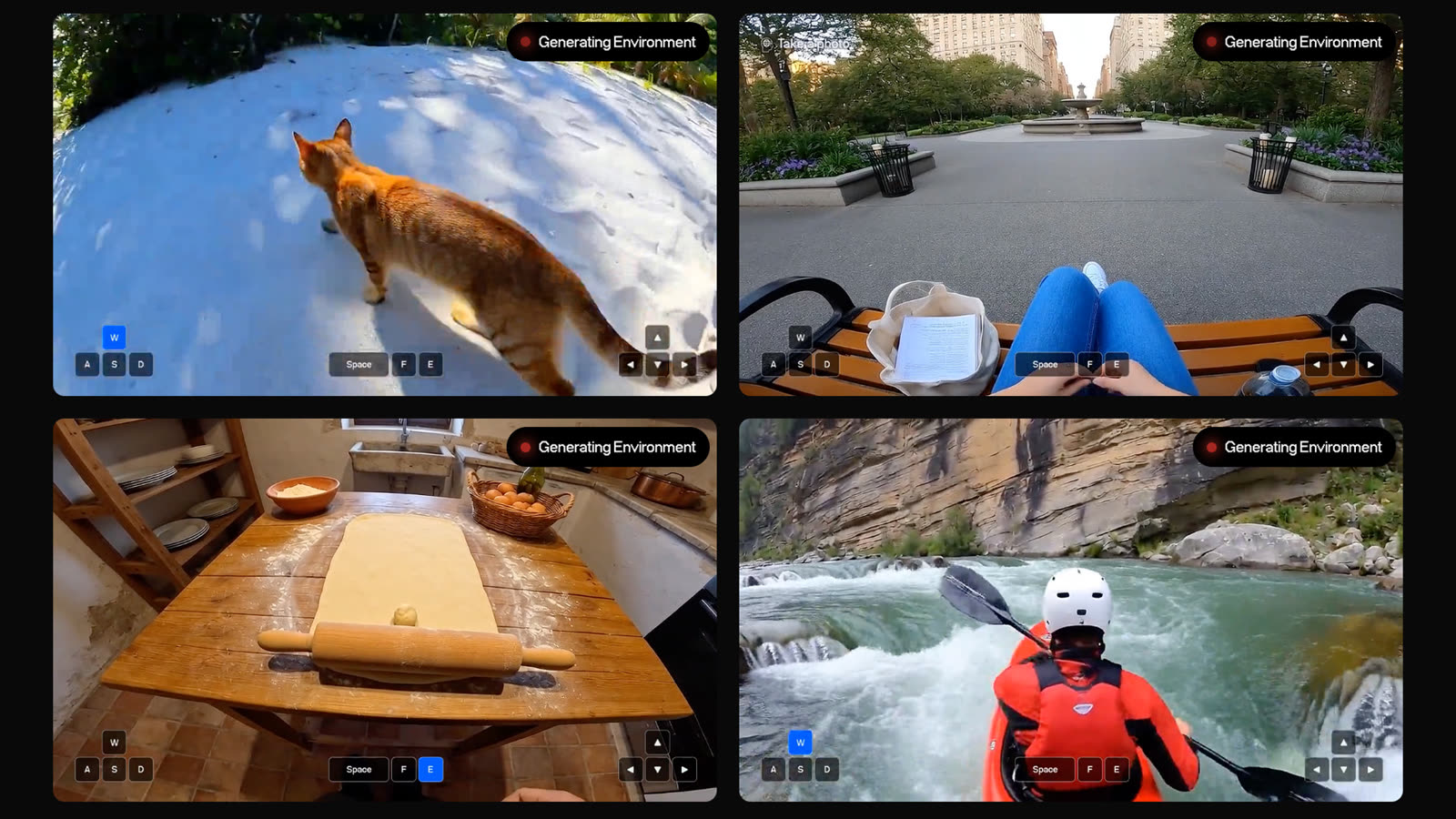
California-based artificial intelligence startup Odyssey has made its generative world model, Odyssey-3, publicly available through a research preview. The system allows users to generate interactive environments from simple text descriptions and explore them in real time. Founded in 2023 by Oliver Cameron and Jeff Hawke, the company initially unveiled the model in September with a primary focus on video games, autonomous driving, and robotics. The recent update introduces public access, technical documentation, and performance benchmarks.
Exploring the Interactive Demo
The free online version runs on Odyssey-3 Flash, creating interactive spaces directly from text prompts. Users can navigate through the generated areas from either first-person or third-person perspectives, trigger distinct events, and observe how the system responds instantly.
Under the hood, Odyssey-3 utilizes an autoregressive diffusion transformer architecture. This framework builds continuous video frames based on prior frames and user inputs. According to the company, the model acquires an understanding of physical relationships and cause-and-effect dynamics by analyzing visual data during its training phase. This dataset incorporated internet videos paired with descriptions, video game recordings alongside keyboard and mouse inputs, and simulated physical interactions. An optimization technique reduces the necessary compute steps to achieve real-time generation.
The foundational Odyssey-3 model features 14 billion parameters and outputs video at an 832 by 480 pixel resolution, while the Odyssey-3 Pro variant supports 1280 by 720 pixels.
Benchmark Performance and Robotics Applications
Odyssey-3 Pro achieved a score of 66.1 points on the Physics-IQ Verified video-to-video benchmark, which assesses physical behavior across thermodynamics, magnetism, solid mechanics, optics, and fluid mechanics. However, the company noted a significant caveat: this score derived from a single test run using a selection method that picked one out of eight generated videos, rather than adhering to the standard four-run requirement with a reported standard deviation. Without that selection method, the model averaged 63.37 points across four runs.
On the WorldMark benchmark, the model claimed top positions in three categories: First-Person Stylized, Third-Person Real, and Third-Person Stylized, while securing third place in First-Person Real.
Odyssey intends to deploy its world model across multiple domains, pairing it with specialized controllers that translate predictions into direct commands. In tests, the model controlled multiple robotic arms using a few dozen hours of demonstration data, and partnered with Swiss firm Flexion for humanoid robotics applications. Additionally, the company demonstrated a drone controller navigating virtual indoor obstacles and an autonomous agent playing video games like GTA V.
What it means for developers
For engineers and researchers, the public research preview of Odyssey-3 opens up new possibilities for experimenting with generative environment simulation, physics prediction, and spatial AI. As world models continue to evolve alongside text and multimodal systems, developers looking to integrate versatile capabilities can try top AI models cheaply through one API at https://apixoai.online. Exploring these foundational architectures helps teams build better agents, robotics controllers, and interactive simulations without being locked into a single provider.
Source: Odyssey-3 is a new generative world model that you can try for free — The Decoder. Written by the Apixo team from that report.
One key for Claude, GPT, GLM, DeepSeek and more. Pay per token with crypto.
Get your API key