OpenAI Releases 719 Theoretical Math Papers Generated by Internal Model
OpenAI has published 719 mathematics papers covering 34,669 pages, advancing theoretical bounds in clustering, string matching, and data science algorithms.
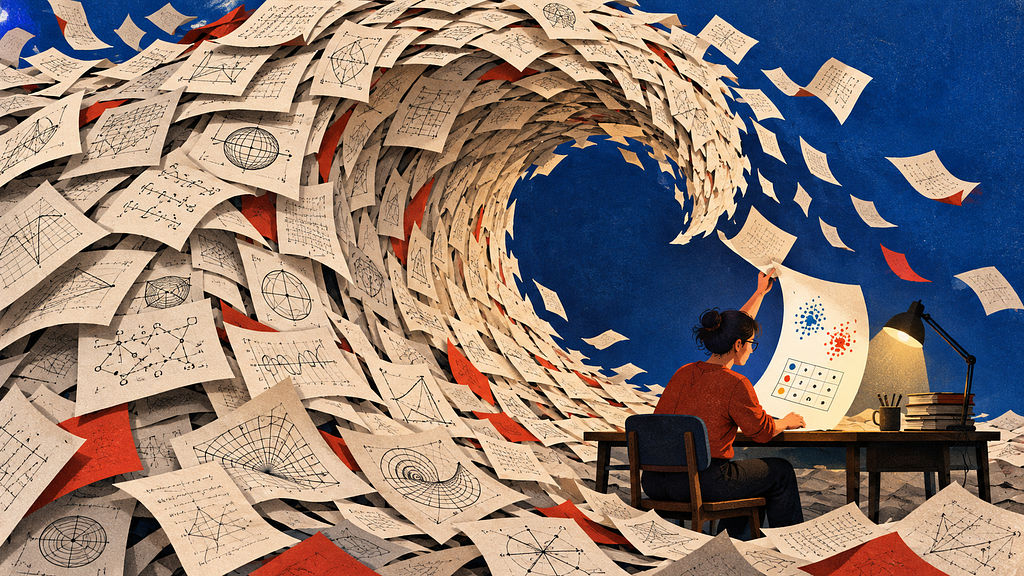
OpenAI has published a massive archive of 719 mathematical research papers grouped into 372 result families, all produced by an unreleased internal artificial intelligence model. Spanning 34,669 PDF pages across 17 disciplines, the release explores fundamental questions in theoretical computer science, statistical mechanics, and applied data processing. The median paper runs 39 pages, with theoretical computer science representing the highest number of result families at 40, while probability and statistical mechanics accounts for the largest volume of text at 7,232 pages across 29 families.
The volume of research prompted computer scientist Scott Aaronson to compare the experience to a rainforest hunter-gatherer suddenly living next to a modern resort, an analogy he shared in The Mathocalypse. Aaronson characterized the model's output as resembling the work of a junior researcher equipped with exceptional breadth, persistent inquiry, and the capacity to synthesize techniques across disciplines.
Algorithmic advances across foundational data problems
A substantial portion of the catalog addresses standard computational and data-science tasks, providing updated performance guarantees for classical algorithms. In text processing, one paper introduces an edit-distance estimation technique where computational effort grows nearly linearly relative to text length under a fixed percentage error allowance. By incorporating randomness, the procedure guarantees an estimate within the target error margin at least two-thirds of the time, improving on previous guarantees for string comparison.
Clustering algorithms also received revised mathematical limits. In the k-median problem, which identifies representative points to minimize aggregate distance across a dataset, previous general approximation guarantees bounded worst-case costs around 200 relative to an optimal score of 100. The newly published technique establishes a tighter approximation ceiling approaching 173.6. Other papers establish uniform sampling guarantees for contingency tables with arbitrary totals, explore lower bounds on sample sizes when fitting models under strict memory budgets, and prove dimension-reduction bounds for non-standard metric spaces where distances are calculated using fourth powers.
The divide between proofs and running code
While the release delivers stronger mathematical ceilings, turning these theorems into practical production software presents significant hurdles. The k-median algorithm, for example, relies on an initial linear relaxation with partial depot openings before rounding them into whole locations. Implementing the published recipe literally would require partitioning a single location into more than 6 × 10²⁸ fragments, which would take billions of years to process sequentially at a rate of one trillion items per second.
Rigorous verification remains a central aspect of the release. OpenAI supplied formal proofs verified by the Lean interactive theorem prover for primary results across 300 of the 719 papers, representing roughly 42 percent of the catalog and linking to 242 of the 372 result families. Even with automated checking, human oversight has proven necessary: repository logs show three papers were withdrawn after a sign error undermined one construction and two downstream papers that relied on it.
Researchers are actively unpacking the results. Theoretical computer scientist Dana Moshkovitz, who has spent roughly two decades studying the Unique Games problem, initially described the construction in one proof as unfamiliar and difficult to navigate. After interacting with an AI assistant named Astra to review the steps, she reported gaining an understanding of the underlying logic and praised its novel concepts.
What it means for developers
For software engineers and data practitioners, the catalog demonstrates that AI systems can uncover algorithmic methods that outperform longstanding mathematical bounds. However, these papers represent theoretical existence proofs rather than ready-to-run libraries. Developing practical tools will require engineers to simplify the proposed formulations, eliminate impractical fragmentation steps, and test performance against standard industry heuristics.
The community has already started integrating these findings into machine learning research. Hugging Face turned 369 of the release's mathematical challenges into reinforcement-learning environments, allowing smaller open models to train against formal verifiers without requiring access to OpenAI’s proprietary weights. As researchers continue using automated systems to push computational limits, developers can try top AI models cheaply through one API at https://apixoai.online to experiment with frontier reasoning tools.
Ultimately, the value of the release lies in revealing that better algorithmic limits are possible. Translating those mathematical bounds into operational code will now depend on developers adapting the underlying reasoning to fit real-world computing environments.
Source: What OpenAI’s 719 Maths Papers Mean for Data Science — Towards AI. Written by the Apixo team from that report.
One key for Claude, GPT, GLM, DeepSeek and more. Pay per token with crypto.
Get your API key