Runway Open-Sources Praxis-1, a Video-Trained AI Model for Robot Control
Runway has released the open weights and source code for Praxis-1, an Apache 2.0 licensed AI model that uses video pretraining to predict and execute robotic movements.
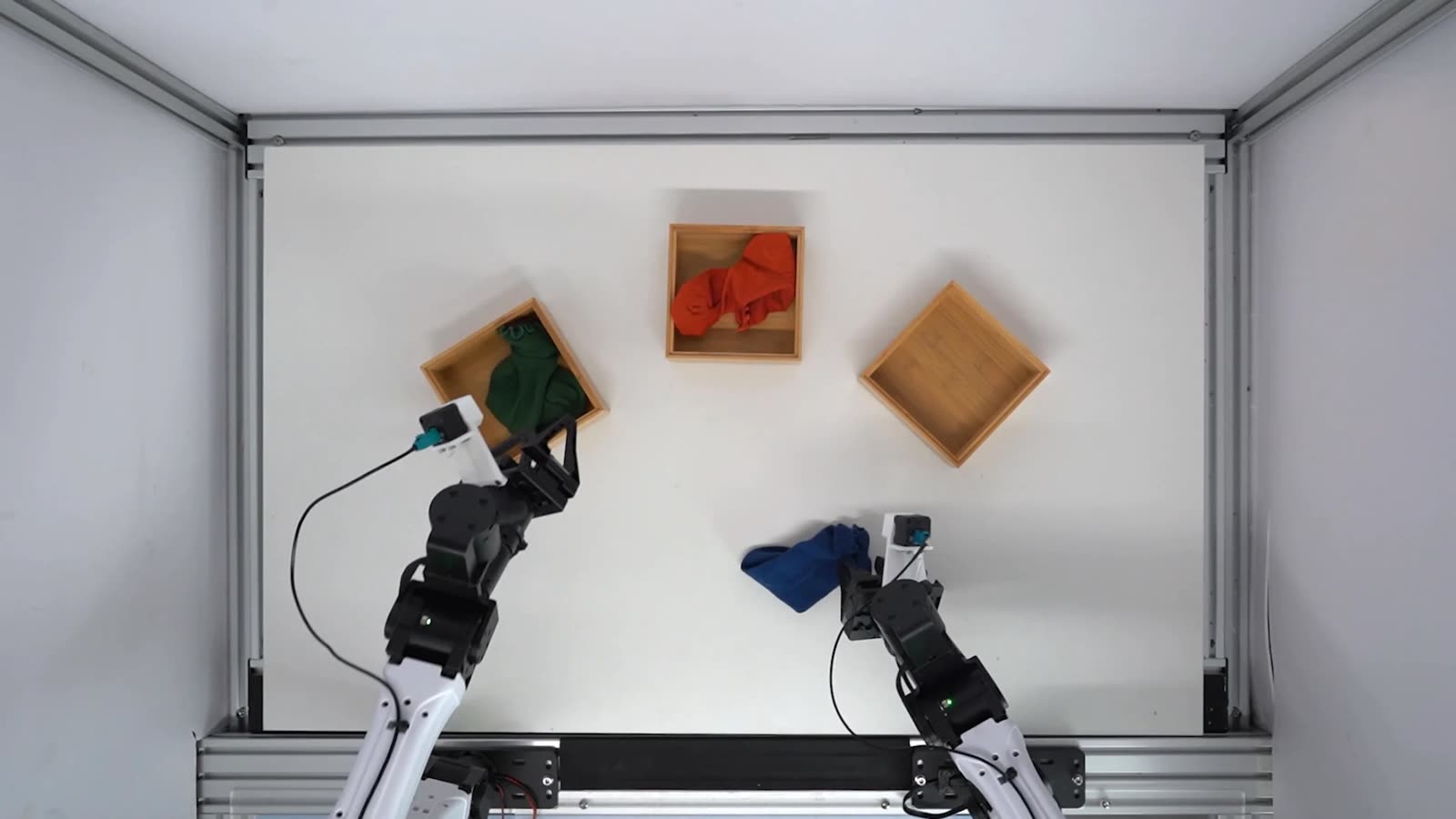
AI company Runway has made its robotics AI model, Praxis-1, publicly available by releasing its open weights and source code under the Apache 2.0 license. First revealed to select partners in late September, the system translates general video training into precise control signals for physical hardware. The open release is accompanied by a technical research report outlining the model's capabilities, architecture, and performance across both simulated benchmarks and real-world hardware.
Praxis-1 is designed as a World Action Model. Instead of relying solely on massive, specialized robotics datasets, the model builds upon Runway's existing generative video research, including foundation work behind models like Gen-4.5. It processes visual inputs from camera frames, textual commands, and telemetry on the robot's current spatial position. By predicting how a physical scene will transform frame by frame, Praxis-1 continuously calculates the appropriate movement commands required to achieve a target outcome. To bridge video understanding with physical execution, Runway fine-tuned the base architecture using footage of human activities alongside recorded robotic movements.
Benchmark performance and real-world testing
Runway released test results comparing Praxis-1 against alternative control models, though the company notes these evaluations have not yet been independently verified. On Nvidia's RoboLab-120 benchmark—which measures performance across 120 simulated sorting, stacking, and grasping tasks—Praxis-1 achieved a success rate of 46.2 percent. This result places it first in the World Action Model category, outperforming FLUX 3 Action's 42.9 percent score, and fifth on the overall leaderboard behind two AI agents and two alternative robotic architectures.
In physical testing on a Franka robot arm, fine-tuned using roughly 277 hours of recordings from the open-source DROID dataset, Praxis-1 completed 88 out of 100 trials across ten distinct tasks, such as shutting drawers and placing items on plates. FLUX 3 Action completed 80 out of 100 on the same test set. For dual-arm setups, training required between 1,400 and 2,600 hours of data.
Runway also tested the architecture's adaptability to unfamiliar hardware using telemetry from Google’s RT-1 mobile manipulator platform, which was excluded from initial pretraining. After fine-tuning on roughly 95 hours of platform-specific data, Praxis-1 reached an 80 percent average success rate in simulation across four task categories. By comparison, Google's original RT-1 model recorded a 52.4 percent success rate on the same benchmark. Early partner testing since September has included deployments by Standard Bots, Noble Machines, and Ultra across humanoid systems, single industrial arms, and dual-arm warehouse robots.
Hardware requirements and practical limitations
The open-source code for Praxis-1 is hosted on GitHub, with model weights accessible on Hugging Face subject to access terms. Runway provides pre-adapted variants for specific platforms alongside the base model, which requires tailored fine-tuning before operating on new hardware configurations. Operating the standard variant demands significant hardware resources, requiring a GPU with at least 80 GB of VRAM. A quantized, compressed version is designed to run within 32 GB of VRAM—potentially fitting consumer hardware like an RTX 5090—though peak memory consumption during active inference has not been empirically verified in the documentation.
Despite its strong execution performance, Praxis-1 exhibits clear operational boundaries. According to Runway's research, the model occasionally misidentifies visually similar objects and struggles when provided with ambiguous text instructions. It also lacks long-horizon reasoning capabilities, meaning multi-step sequences must be explicitly broken down into individual sub-tasks rather than planned autonomously.
What it means for developers
The open release of Praxis-1 gives developers and robotics researchers an accessible foundation under the permissive Apache 2.0 license. By leveraging video pretraining to understand physical dynamics, the architecture may significantly reduce the volume of custom, expensive hardware datasets required to train effective robotic controllers.
Because Praxis-1 acts primarily as a high-speed execution layer rather than a complex reasoning engine, practical deployments will likely rely on a dual-architecture setup. Developers can pair execution models like Praxis-1 with high-level reasoning models that decompose complex operational goals into step-by-step instructions. For builders integrating multi-model pipelines, platforms like Apixo (https://apixoai.online) offer cost-effective, pay-per-token API access to leading models like Claude, GPT, Gemini, Grok, and DeepSeek using a single API key.
As pre-adapted checkpoints become available, software teams can test real-time visual movement prediction without building proprietary world models from scratch, opening new pathways for accessible robotics development.
Source: Runway's open-source Praxis-1 turns video AI into a robot controller — The Decoder. Written by the Apixo team from that report.
One key for Claude, GPT, GLM, DeepSeek and more. Pay per token with crypto.
Get your API key