Scaling Agentic AI Safely: Inside the New Enterprise AWS Blueprint
Discover how a new reference blueprint using Amazon Bedrock AgentCore helps enterprises govern, scale, and secure multi-account agentic AI workflows across teams.
Moving artificial intelligence agents out of testing and into live production environments introduces challenges that go far beyond model selection and prompt engineering. While developers often focus on tool use and model accuracy, the primary friction points involve organizational security boundaries, resource ownership, error handling limits, and financial tracking across multiple internal business units. When multiple engineering teams build autonomous systems without standardized infrastructure, security configurations drift, shared services become operational bottlenecks, and auditing accountability grows difficult.
To address these hurdles, a comprehensive architectural blueprint has been introduced for building an Enterprise Agentic AI Platform using Amazon Bedrock and Amazon Bedrock AgentCore. This setup provides modular services designed to manage agents at scale—covering runtime environments, access gateways, identity verification, memory allocation, policy enforcement, model registries, and automated evaluations. Rather than relying on manually configured agents or sharing a single overloaded account, the architecture establishes a federated operating model that balances central governance with independent team delivery.
Core Architecture and Operating Models
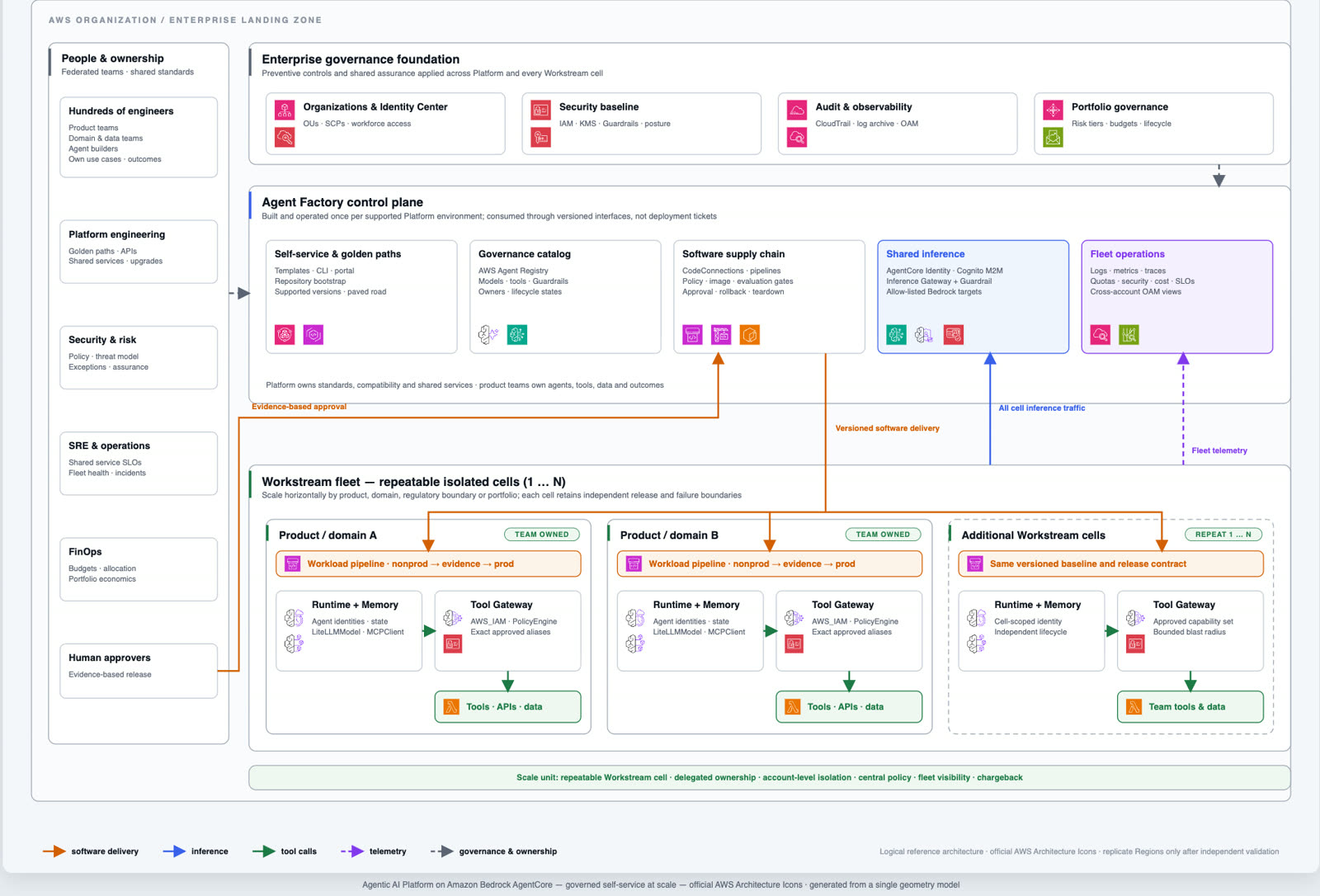
Enterprises typically choose between centralized, decentralized, or federated operating models for AI deployment. A centralized structure often bottlenecks progress as a single team handles every request, whereas a decentralized approach causes security drift and fragmented spending visibility. The federated model bridges this gap by positioning a central Platform team as a hub that manages golden paths, approved model lists, and shared inference gateways, while domain-focused Workstream teams retain ownership of their application logic, prompts, and specific tool sets.
To enforce these boundaries, the architecture is divided into distinct operational planes and account layers:
- Management and Governance Foundation: Utilizes AWS Organizations and IAM Identity Center for high-level preventive policies, audit retention, and cost tracking.
- Security and Observability: Employs tools like AWS CloudTrail, Security Hub, and Amazon CloudWatch Observability Access Manager (OAM) to give central operators fleet visibility without granting write access to team workloads.
- Platform Control Plane: Operates shared inference gateways, publishes versioned agent templates supporting frameworks like LangGraph, CrewAI, and Strands, and orchestrates reviewed releases.
- Workstream Cells: Isolated boundaries for individual product or domain teams containing an AgentCore Runtime, actor-scoped AgentCore Memory, and an authenticated Model Context Protocol (MCP) tool gateway.
Every external inference request must route through a governed gateway that applies guardrails, restricts model usage to approved regional parameters, and enforces strict rate limits and token quotas. Similarly, tools can only be invoked through an authenticated gateway using least-privilege execution roles and Cedar policies.
What it means for developers
For developers and product teams, this multi-account pattern creates a clear, automated pathway from code creation to production release without requiring manual deployment tickets or direct administrative write permissions. Developers can try top AI models cheaply through one API at https://apixoai.online.
Updates must pass through a strict CI/CD pipeline rather than manual adjustments. The deployment process begins with an immutable source review, followed by code compilation, policy validation, and automated checks using cdk-nag. Once the workload pipeline deploys resources into a nonproduction boundary, evaluation gates test the live runtime against regression, refusal behavior, first-token latency, and cost.
Crucially, these evaluation gates incorporate adversarial testing: the system confirms that authorized calls succeed while unauthorized model requests or out-of-bounds tool calls are correctly denied. If an expected denial fails to trigger, the build fails automatically. Human reviewers then inspect the verification evidence before promoting the release to production, ensuring secure operations and reliable rollback pathways throughout the agent lifecycle.
Source: Building an Agentic AI Platform on Amazon Bedrock AgentCore | Amazon Web Services — AWS Machine Learning. Written by the Apixo team from that report.
One key for Claude, GPT, GLM, DeepSeek and more. Pay per token with crypto.
Get your API key