Securing MCP Systems: Zero Trust Frameworks and Identity Protocols for Autonomous Agents
A recent security assessment found that 91.8% of public Model Context Protocol servers lack proper authentication. Here is how Zero Trust architecture can fix agentic security flaws.
Enterprise deployments of autonomous AI agents using the Model Context Protocol (MCP) face serious security vulnerabilities when transitioning from isolated development environments into production. Standard MCP topologies typically rely on unauthenticated standard input/output (STDIO) transport layers or ambient service credentials tied to host machines. This structural design permits untrusted input to execute arbitrary commands across internal systems, leading to risks such as prompt-driven command hijacking and data exfiltration.
Security flaws in standard MCP deployments
A dynamic security evaluation using the Corvus framework across 414 internet-facing MCP servers showed that 91.8% of public deployments operated without fundamental authentication or OAuth boundary controls. Hundreds of these instances exposed root shell access and server-side request forgery endpoints directly to cloud metadata services. Furthermore, 41.6% of vulnerable endpoints cycled offline within a 72-hour window, rendering traditional static vulnerability patching schedules obsolete against ephemeral agent infrastructure.
A key failure mode in current deployments is approval laundering. This occurs when a human operator grants cryptographic approval for a high-level tool command, such as diagnostic checks, while natural language metadata hidden inside the prompt quietly alters downstream execution pathways. In such scenarios, the agent can transitively read sensitive files like /root/.aws/credentials or open unauthorized network connections to external destinations. Because the initial top-level action received formal operator approval, compliance logs record the operation as legitimate, masking the unauthorized data exfiltration.
Relying on system prompts to enforce safety guarantees fails to protect systems. Empirical red-teaming shows that attack techniques like the Tree of Attacks with Pruning (TAP) framework achieve approximately a 45% success rate against various frontier language models. Additionally, open-source language models exhibit package and tool hallucination rates of up to 21.7%, which attackers exploit by registering hallucinated dependencies or poisoning tool metadata.
The Zero Trust architectural blueprint
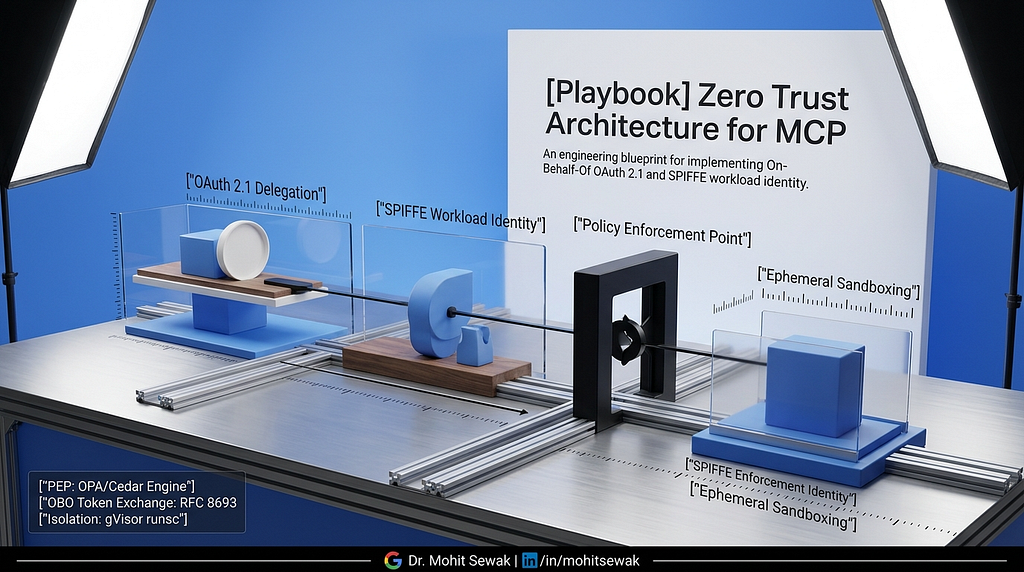
To mitigate these risks, security engineers must dismantle direct client-server coupling in MCP deployments by placing a Policy Enforcement Point (PEP) or Semantic Gateway between the agent host and underlying MCP tools. In this Zero Trust architecture, every tool call is treated as an untrusted transaction verified using SPIFFE workload identities, RFC 8693 On-Behalf-Of (OBO) token exchanges, and explicit parameter checks.
Under an RFC 8693 token exchange flow, long-lived API keys are completely stripped from MCP environments. The gateway converts user session tokens into short-lived, parameter-bound execution tokens specific to single tool invocations. A Policy Decision Point (PDP) running Open Policy Agent (OPA) or Cedar middleware intercepts raw JSON-RPC payloads to enforce parameter constraints—such as verifying SQL query structures—out-of-band before execution occurs.
To contain localized code execution risks, STDIO-based servers should run within ephemeral gVisor microVM sandboxes configured with read-only root filesystems and disabled network egress. Decoupling authorization logic from the probabilistic language model runtime ensures safety guarantees remain mathematically intact regardless of prompt-injection attempts.
What it means for developers
Adopting a Zero Trust framework for MCP requires balancing security benefits against real operational trade-offs. Implementing token delegation and OPA policy checks introduces 15ms to 35ms of latency per tool call. For multi-step agents executing 10 to 50 sequential tool calls per prompt, this overhead accumulates to between 150ms and 1.75s per user interaction. Furthermore, cold-starting ephemeral gVisor sandboxes adds 80ms to 200ms unless pre-warmed container pools are used.
Hardware economics and KV cache security also present design challenges. To block side-channel attacks where malicious users analyze shared prefix caches to extract sensitive contextual data, systems must apply cryptographically salted session prefixes. Disabling cross-tenant prefix caching, however, increases GPU memory bandwidth bottlenecks and degrades Time to First Token (TTFT) metrics by 30% to 55% during high concurrency.
Developers implementing these safeguards can follow a three-phase operational runbook:
- Day 1: Replace unprotected STDIO transports with rootless, network-isolated gVisor sandboxes.
- Day 7: Remove long-lived cloud credentials and implement out-of-band RFC 8693 OBO token delegation.
- Day 30: Move all tool authorization into deterministic OPA or Cedar schemas, treating all agent-generated parameters as untrusted inputs.
When designing, testing, and benchmarking complex multi-model pipelines against these strict security standards, developers can try top AI models cheaply through one API at https://apixoai.online.
Source: [Playbook] Zero Trust Architecture for MCP — Towards AI. Written by the Apixo team from that report.
One key for Claude, GPT, GLM, DeepSeek and more. Pay per token with crypto.
Get your API key