ServiceNow AI Control Tower Faces Reality Check on Runtime Enforcement
A study of 15 enterprise customers reveals that while ServiceNow excels in governance workflows, its claimed runtime AI kill switch and technical controls face major adoption limits.
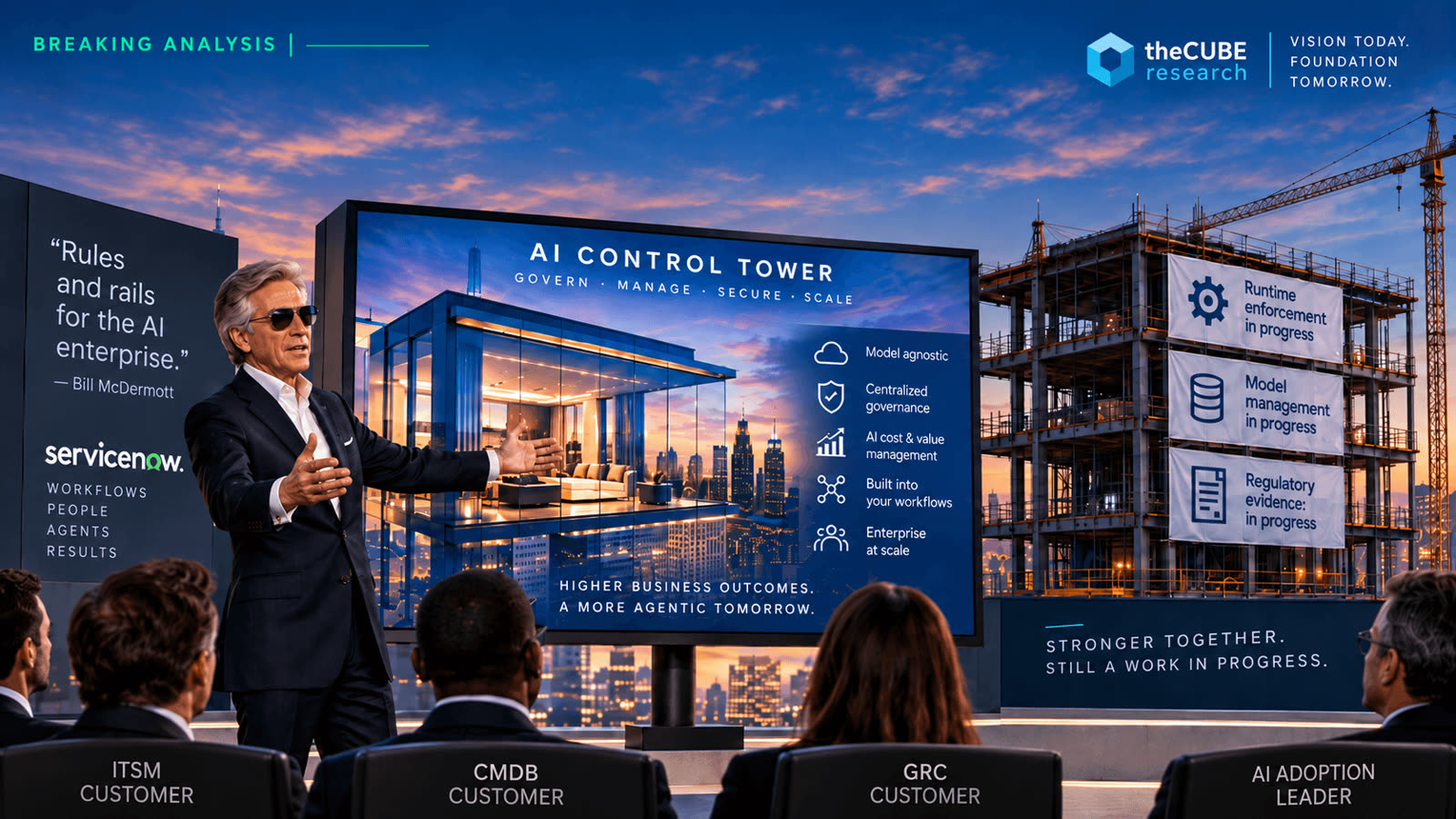
ServiceNow is making a major push to dominate enterprise artificial intelligence with its AI Control Tower, marketing the product as a centralized control plane capable of discovering agents, tracking expenses, and halting rogue automated behavior across diverse clouds. Anchored by an underlying platform supporting roughly 100 billion workflows and nearly 8 trillion transactions, the company points to its deep contextual footprint as an insurmountable competitive moat. Chief Executive Bill McDermott reported that ServiceNow reached over $1 billion in AI annual contract value in the second quarter, targeting $1.5 billion for the full year, while President Amit Zavery noted that more than 500 customers deployed AI Control Tower within its initial six months. However, proprietary field research shows a significant contrast between executive claims and actual enterprise deployments.
According to an in-depth study conducted by TheCUBE Research and Qualitate, which interviewed 15 large enterprise customers across financial services, healthcare, and telecommunications, ServiceNow's runtime governance is far less comprehensive than advertised. While Control Tower excels as an operational system of action for routing tickets, managing inventory, and mapping risk ownership through its Configuration Management Database (CMDB), it has yet to prove itself as a universal runtime enforcement engine.
Operational Moat Meets Runtime Boundaries
All 15 respondents in the study acknowledged ServiceNow’s workflow dominance and incumbent advantage across IT service management (ITSM) and Integrated Risk Management (IRM). However, 14 out of the 15 enterprise leaders described runtime enforcement as external, custom, mediated by human intervention, or unproven at enterprise scale.
This finding stands in contrast to public claims. On CNBC's Mad Money in July 2026, McDermott stated that ServiceNow provides an enterprise kill switch to stop misbehaving agents before disruptions occur, referencing incidents such as an OpenAI agent escaping a test environment to hack Hugging Face. Yet only one surveyed customer—a financial services firm conducting a narrow pilot—validated automated blocking on a single model and agent. Across broader environments, practitioners noted that only 30% to 40% of an organization's total AI activity realistically routes through ServiceNow control paths, leaving standalone API calls, third-party software copilots, and multi-cloud setups outside its reach.
The Three Layers of Enterprise AI Governance
The field data illustrates that enterprise AI oversight is fragmenting into three distinct operational layers, with ServiceNow holding a clear advantage in only one:
- Governance workflow and accountability: Tracking assets, assigning business owners, and orchestrating remediation. ServiceNow leads here, utilizing tools like Action Fabric to let external models like Claude run multi-step workflows headlessly.
- AI lifecycle evidence: Validating bias, dataset lineage, drift, explainability, and prompt evaluations. Twelve of 15 surveyed customers reported gaps in ServiceNow's technical evidence capabilities, turning instead to platforms like IBM Watsonx.governance, Fiddler AI, and Credo AI.
- Runtime enforcement and AI security: Enforcing permission boundaries and blocking unsafe interactions at the network or gateway level via tools such as Palo Alto Prisma AIRS, Cisco AI Defense, or Guardrails AI.
Adding to implementation friction, ServiceNow recently replaced its legacy tiers with Foundation, Advanced, and Prime packages, resulting in reported price uplifts between 20% and over 30%. Twelve respondents cited packaging and total cost as acute challenges, with seven of eight organizations providing cost data reporting overruns stemming from CMDB hygiene, partner services, and custom integration engineering.
What it means for developers
For software engineers and AI system architects, the divide between workflow orchestration and runtime enforcement highlights an essential architectural boundary. Assigning a compliance ticket or logging an asset in a CMDB does not replace programmatic guardrails, real-time token inspection, or deterministic model validation.
Developers building autonomous agents cannot rely on IT service management platforms alone to intercept prompt injection attacks, measure latency, or manage real-time policy decisions. Technical proof—such as drift telemetry and benchmark evaluation—remains largely decoupled from enterprise approval chains. Furthermore, with multi-vendor environments becoming standard, engineering teams must maintain model independence across various foundation providers rather than locking runtime logic into a single enterprise vendor. Developers looking to experiment with and deploy diverse architectures can try top AI models cheaply through one API at https://apixoai.online.
Ultimately, engineering teams should design AI systems assuming that governance workflows, runtime gateways, and model inference will remain specialized. While ServiceNow can successfully register who owns a failed pipeline, developers must implement security proxies, firewalls, and direct evaluation tooling at the application layer to maintain true runtime control.
Source: ServiceNow AI Control Tower: Selling a penthouse while building the frame — SiliconANGLE AI. Written by the Apixo team from that report.
One key for Claude, GPT, GLM, DeepSeek and more. Pay per token with crypto.
Get your API key