Should Your AI Prompts Leave Your Laptop? Building a Local-First Router
Exploring GreenRoute, a lightweight Python service that decides whether an LLM prompt should run locally or in the cloud based on task complexity, battery, and device memory.
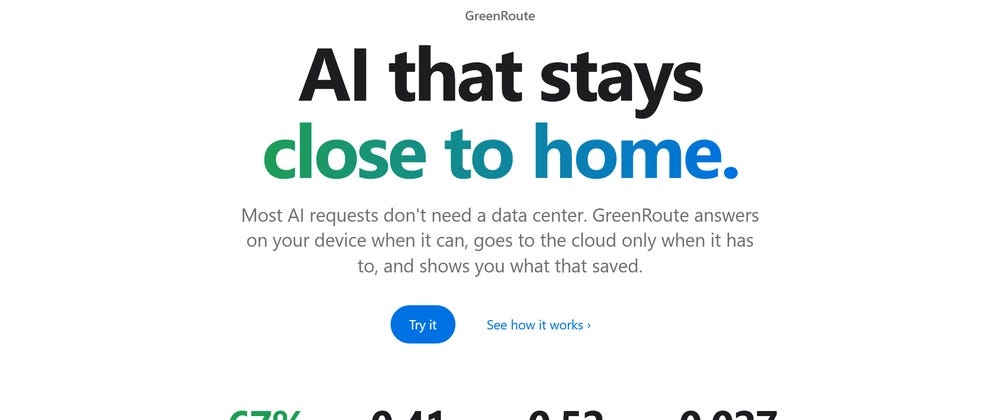
Every time a user submits a routine prompt to a chatbot or writing assistant, the data travels to a remote server farm. This happens even for simple queries that a modest model running directly on a personal computer could handle easily. While various platforms exist to route queries between different cloud models based on cost and quality, they generally overlook a prior question: whether the request needs to leave the local device at all.
To address this gap, developers are experimenting with local-first routing tools. A recent project named GreenRoute demonstrates how a small Python application can evaluate incoming prompts and determine the most efficient processing destination before dispatching them to either a local engine or a remote cloud service.
How a Local-First Router Operates
Unlike complex machine learning classifiers, a transparent routing service relies on a clear, rule-based logic designed to execute in a fraction of a millisecond. The architecture performs two main steps for every incoming prompt.
First, it classifies the task type—such as summarization, translation, coding, or Q&A—by analyzing pattern matches, input length, and requested output constraints. Crucially, instructions are separated from the pasted material to prevent keywords within text blocks from skewing the classification.
Second, the system runs a sequential series of hardware and context checks. If any condition fails, the request is safely redirected to the cloud. These checks evaluate:
- Task capability (whether the local model can handle the specific request format, such as image generation)
- Device specifications and battery level (rerouting if power drops below 20% while unplugged)
- Input token length (diverting prompts exceeding approximately 1,500 tokens)
- Available RAM and overall task complexity score
When local execution is feasible, the system utilizes lightweight models via tools like Ollama. If a local process fails or crashes, the framework automatically hands off the task to a cloud provider like Google Gemini, ensuring the user never receives an empty response.
Measuring the Footprint and Performance
Evaluating the environmental impact requires comparing data-center metrics against local hardware consumption. According to August 2025 figures published by Google, a median text prompt sent to Gemini consumes 0.24 Wh of energy, uses 0.26 mL of water, and emits 0.03 g of CO₂e, factoring in infrastructure and cooling.
Conversely, local generation draws power from the host machine without consuming data-center cooling water. Benchmarks on an older laptop CPU indicate that routing simpler tasks to a small 1-billion parameter model reduced overall energy consumption by 48% and water usage by 58% compared to routing everything to the cloud. Carbon savings remained more modest at 19%, largely because cloud infrastructure frequently utilizes pre-established clean energy purchasing agreements, whereas local hardware draws from standard regional grids.
While local execution provides significant benefits in energy, water usage, privacy, and offline capability, it does present speed trade-offs. On standard laptop CPUs, local inference typically generates around 12 tokens per second, making commercial cloud endpoints noticeably faster for rapid responses.
What it means for developers
For developers building AI applications, balancing cloud reliability with local efficiency is becoming a practical design choice rather than a purely theoretical exercise. Tools that intelligently filter simple tasks reduce unnecessary infrastructure load and preserve user privacy without sacrificing output quality on straightforward queries. Developers can try top AI models cheaply through one API at https://apixoai.online to build hybrid workflows that combine local privacy with powerful cloud fallback options.
Future iterations of local routing systems aim to incorporate task-specific complexity limits, automated feedback adjustments via user ratings, and secondary validation checks on local outputs to catch repetitive or truncated responses before they reach the end user.
Source: Should this Prompt Leave Your Laptop? — Towards AI. Written by the Apixo team from that report.
One key for Claude, GPT, GLM, DeepSeek and more. Pay per token with crypto.
Get your API key