Simulating Student Learning to Build Better AI Tutors
Microsoft Research introduces StudentSim, a framework for simulating student responses and guidance uptake to improve AI tutoring systems before classroom deployment.
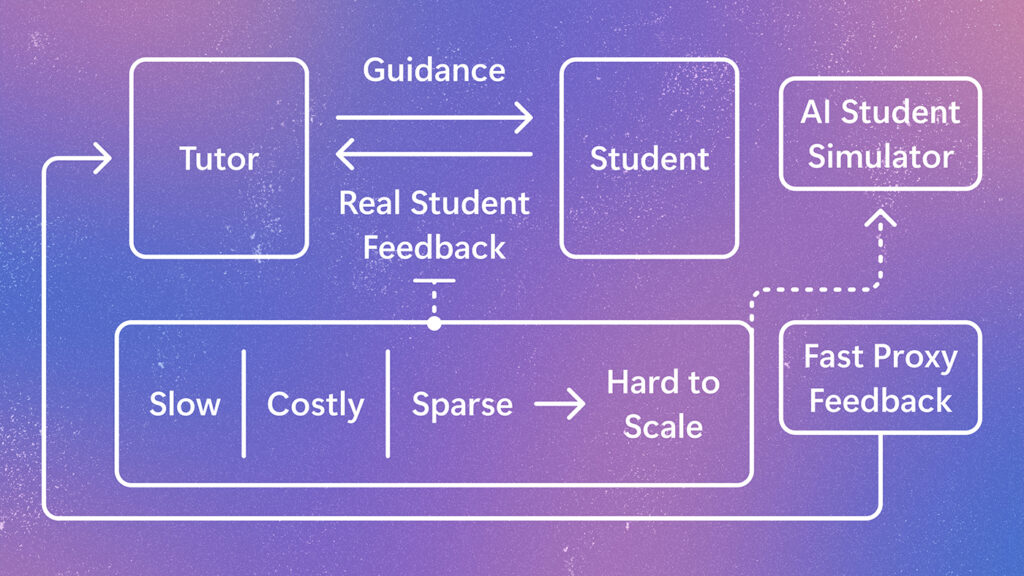
Developing effective artificial intelligence tutoring tools requires understanding how students react to explanations, hints, and corrections. Gathering this feedback through traditional human studies is slow, expensive, and difficult to scale, which limits how quickly researchers can iterate on model designs. To address this bottleneck, researchers have introduced StudentSim, a research framework designed to evaluate and improve AI tutors using personalized student simulators.
It is important to note that StudentSim is strictly a research tool. It is not a commercial product, is not deployed in real classrooms, and is not designed to replace human teachers. Instead, it offers an early-stage feedback mechanism for developers and researchers working on educational AI models.
Modeling Behavioral Fidelity and Guidance Responsiveness
Creating an accurate digital learner is a complex challenge. Simply asking a large language model to role-play a struggling student often fails because the model retains reasoning capabilities far beyond the student's actual ability level, leading to misleading feedback. Conversely, traditional knowledge tracing models can track historical learning metrics, but they typically cannot process natural-language tutor guidance as an input.
To bridge this gap, StudentSim adapts concepts from education research, specifically drawing on Vygotsky’s zone of proximal development, which differentiates independent performance from performance achieved with support. The framework evaluates simulators across two primary dimensions:
- Behavioral fidelity: Assessing whether the simulator accurately matches a specific student’s recorded responses on held-out problems.
- Guidance responsiveness: Measuring how the simulator updates its answers after receiving explanations or hints from a tutor.
A Two-Stage Training Pipeline
The system utilizes publicly available, de-identified learner datasets to protect privacy, ensuring no personally identifying information is used at any stage. Because individual student records are often sparse, StudentSim employs a two-stage training approach. First, the model trains on data pooled across numerous learners within the same domain to learn common response formats, standard errors, and typical revision patterns. Second, it fine-tunes specifically on the individual records of the target student.
This methodology was tested across three distinct subjects: chess, second-language English writing, and mathematics. When evaluated alongside standard baselines, StudentSim demonstrated superior performance. For instance, in chess evaluations, StudentSim achieved a behavioral fidelity score of 0.5150 and a guidance responsiveness score of 0.9067. By comparison, GPT-5.4 scored 0.2316 and 0.7186, while Maia2—a dedicated human chess move prediction model—scored 0.4535 and 0.2721.
What it means for developers
For developers building educational technologies, StudentSim provides a scalable way to supply reward signals during reinforcement learning. In a tested chess tutor study, a reinforcement learning policy optimized using StudentSim as the simulated student feedback source outperformed both a supervised fine-tuning baseline and a model using GPT-5.4 for simulated rewards, reaching 90.5% accuracy and earning higher marks for guidance quality and personalization from blind human chess experts.
While developers can test top AI models cheaply through one API at https://apixoai.online, systems like StudentSim show how domain-specific simulation pipelines can further refine specialized applications. Ultimately, the system does not eliminate the need for real-world user studies, which remain vital for measuring safety, usability, and actual classroom outcomes. Rather, it streamlines the preliminary research phase, allowing teams to test and optimize teaching strategies before conducting human evaluations.
Source: Simulating student learning for better AI tutoring — Microsoft Research. Written by the Apixo team from that report.
One key for Claude, GPT, GLM, DeepSeek and more. Pay per token with crypto.
Get your API key