Understanding MCP: The Open Protocol Standardizing AI Tool and Data Connections
Learn how the Model Context Protocol (MCP) solves AI tool integration, its architecture, open governance under the Linux Foundation, and critical security best practices.
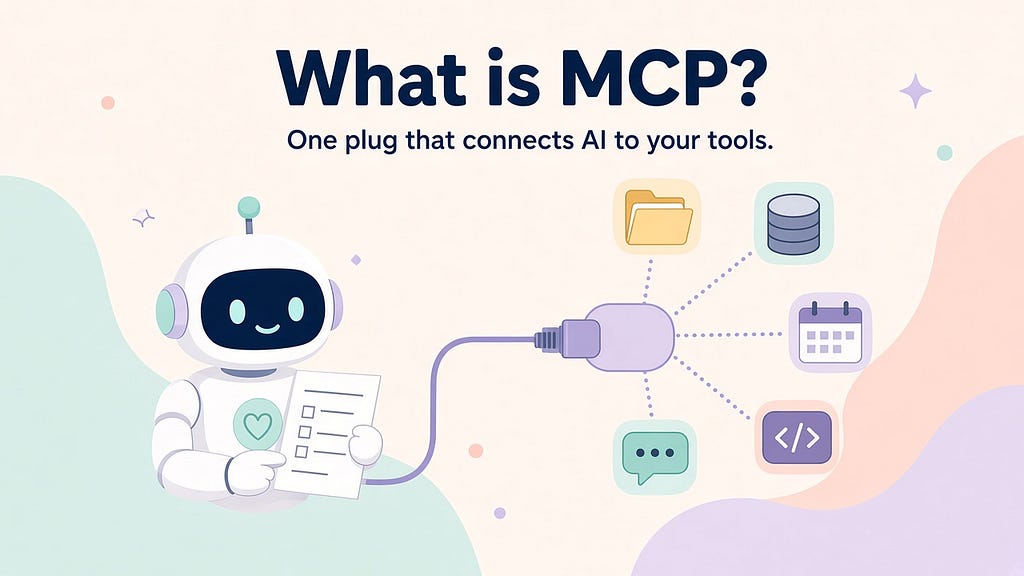
Connecting artificial intelligence applications to external databases, software tools, and enterprise data sources previously required software engineers to write custom integration code for every tool and platform pair. If five AI applications needed access to ten external tools, engineering teams had to build and maintain 50 separate integration points. The Model Context Protocol (MCP), open-sourced by Anthropic in November 2024, addresses this friction by establishing a single standard for context exchange, reducing that workload down to 15 implementations.
Architecture and System Components
MCP establishes a standardized communication protocol using JSON-RPC 2.0 messages transmitted over standard input/output (stdio) for local processes or Streamable HTTP for remote connections. The architecture uses a three-part client-server structure:
- Host: The user-facing AI application, such as VS Code, Claude Desktop, or ChatGPT.
- Client: An internal connector managed by the host for each connected server.
- Server: An external program exposing specific data sources, software capabilities, or workflows.
An MCP server exposes three main types of primitives to host applications. Tools allow the model to take actions like executing SQL queries or reading ticket databases. Resources provide readable context like raw files or database schemas. Prompts supply pre-defined instruction templates for reusable tasks.
When connected, the client issues a tools/list request to discover available features, receiving tool names, descriptions, and structural input schemas. When an underlying model determines a tool is needed, the host issues a tools/call request to execute the targeted code. Developers using Python can implement servers using the official MCP Python SDK, where function type hints automatically generate input schemas and docstrings serve as model-readable tool descriptions.
Ecosystem Growth and Neutral Governance
Adoption of MCP grew rapidly following its initial release. By December 2025, the project logged more than 10,000 active servers alongside client integration across platforms like Cursor, Gemini, Claude, ChatGPT, Microsoft Copilot, and VS Code.
To establish neutral, vendor-independent stewardship, Anthropic transferred MCP governance in December 2025 to the Agentic AI Foundation. Created under the umbrella of the Linux Foundation, the initiative was co-founded by Anthropic, Block, and OpenAI, with support from technology firms including Microsoft, Google, AWS, Cloudflare, and Bloomberg.
What it means for developers
For developers building agentic workflows, MCP means writing connector logic once allows an external system to work across all protocol-compliant host environments. As software engineers test tool integration across diverse LLM providers, platforms like Apixo (https://apixoai.online) offer unified pay-per-token API access to models including Claude, GPT, Gemini, Grok, and DeepSeek through a single key.
However, standardizing tool capabilities introduces distinct security considerations. In April 2025, security researchers at Invariant Labs detailed vulnerabilities known as "tool poisoning." In these scenarios, malicious servers hide malicious prompt injection instructions within tool descriptions, prompting an agent to perform unauthorized actions like exfiltrating private files during routine execution. Researchers also demonstrated "rug pull" risks, where tool descriptions are modified after initial user approval.
To safeguard production environments, developers should adopt several essential practices:
- Install servers exclusively from verified, trustworthy origins.
- Apply the principle of least privilege, restricting server permissions to read-only whenever possible.
- Require explicit human confirmation steps prior to authorizing state-changing operations such as sending emails, deleting data, or initiating payments.
- Treat all data returned from external tools as untrusted input rather than executable instructions.
Source: What is MCP and How It Gives AI One Standard Way to Plug Into Your Tools — Towards AI. Written by the Apixo team from that report.
One key for Claude, GPT, GLM, DeepSeek and more. Pay per token with crypto.
Get your API key