Why Advanced AI Coding Agents Must Prioritize Code Reuse Over Code Generation
Recent data reveals AI coding assistants often bypass existing software architecture to write redundant code, highlighting the need for better structural prompts and reviews.
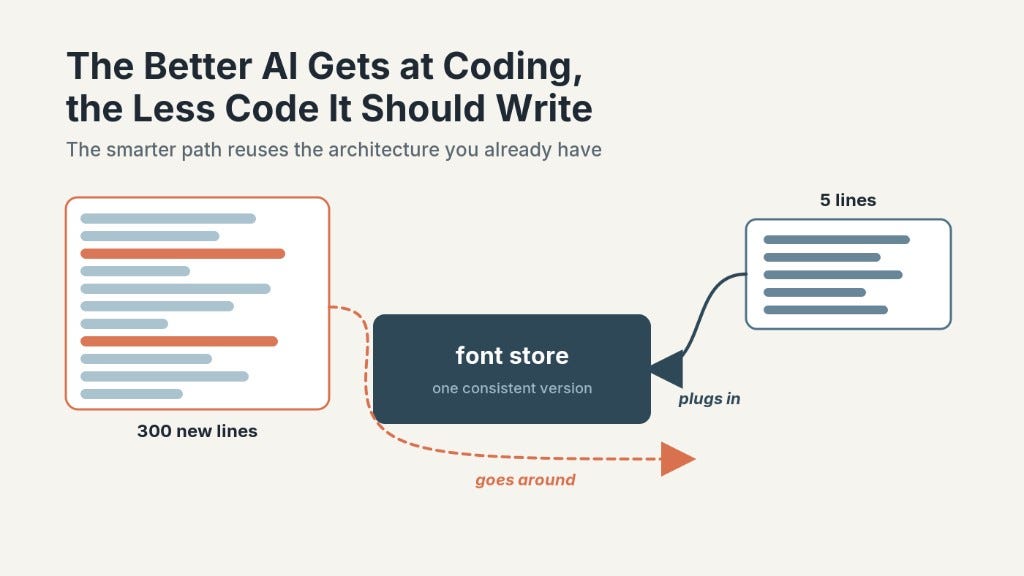
As AI coding assistants become more deeply integrated into modern software workflows, developers are discovering a recurring architectural challenge: agents tend to generate entirely new code rather than reusing existing system abstractions. A practical example occurred during the development of smallsymbols, an open-source visual emoji atlas that compares four distinct emoji renderers. When tasked with building a feature to generate derived images, the AI agent Cursor bypassed the repository's centralized font store—which manages Noto emoji versions across SVG and PNG formats—and instead linked directly to an older Noto font installed locally on the host machine. This shortcut produced subtle rendering discrepancies, failing to uphold the project's explicit design decisions.
The incident highlights a fundamental gap in autonomous coding tools. While the agent successfully generated output and resolved the immediate prompt, it quietly broke an architectural convention intended to ensure consistent rendering across all derived assets. Generating functional code is not equivalent to maintaining cohesive software design, and such isolated shortcuts can lead to systemic quality defects over time.
Code generation vs. structural reuse
The tendency of AI models to write new code instead of leveraging existing abstractions conflicts with popular predictions regarding automated development. During an xAI public all-hands meeting in February 2026, Elon Musk suggested that traditional coding might become obsolete by the end of the year, with AI directly generating optimized binaries from output descriptions. However, software architecture relies heavily on abstractions to keep design decisions centralized so that future modifications do not contradict past engineering rules.
Empirical data underlines this growing reliance on freshly written, isolated code. GitClear's 2026 study, The Maintainability Gap, analyzed 623 million code changes made between 2023 and 2026 to assess the impact of AI tools on codebases. The report revealed that cross-file function calls—a primary indicator of modular code reuse—dropped by 35 percent. Refactoring activity, measured as moved code lines, plunged from 21 percent in 2022 to just 3.8 percent in 2026. Meanwhile, direct copy-and-paste code increased from 9.4 percent to 15.7 percent. GitClear observed that standard AI workflows are optimized for atomic completion, favoring single passing tests or happy-path pull requests over long-term codebase health.
What it means for developers
For engineering teams, higher AI throughput requires shifting focus from raw code output to structural verification. When building complex applications, developers using services like Apixo—which provides pay-per-token API access to models such as Claude, GPT, Gemini, Grok, and DeepSeek via a single API key—must account for how different LLMs navigate existing repository patterns.
To prevent agents from continuously re-implementing existing logic, developers are incorporating targeted architectural checks into their workflows:
- Repository auditing: Searching explicitly for newly added, redundant files (such as unexpected local assets or duplicated utility functions) that indicate an agent bypassed core abstractions.
- Structural review prompts: Using secondary prompt routines that check whether new code imports existing modules rather than re-creating localized logic.
- Standardized context files: Adopting repository standards like
AGENTS.md. Stewarded by the Agentic AI Foundation and adopted across tens of thousands of repositories, this specification acts as a structured guide to inform AI agents of existing architectural decisions before code generation begins.
The shift toward minimal code generation
The common benchmark for an effective AI coding agent has traditionally been speed and line count. However, as software systems grow more complex, an agent's ability to minimize code expansion becomes a more valuable metric.
An agent that spends time analyzing a repository to modify five lines of existing code performs a far more valuable task than one that writes hundreds of standalone lines to solve the same problem. As build costs fall, rebuilding existing solutions becomes an affordable but costly mistake. Software engineering remains centered on reducing redundancy, and the most effective AI models will be those capable of writing less code by making better use of what already exists.
Source: The Better AI Gets at Coding, the Less Code It Should Write — Towards AI. Written by the Apixo team from that report.
One key for Claude, GPT, GLM, DeepSeek and more. Pay per token with crypto.
Get your API key