Wabi Reaches $1.25B Valuation in $55M Seed Round for Consumer AI Assistant
Consumer AI startup Wabi raises $55 million led by IVP at a $1.25B valuation to expand its group chat assistant with vibe coding and third-party app integrations.
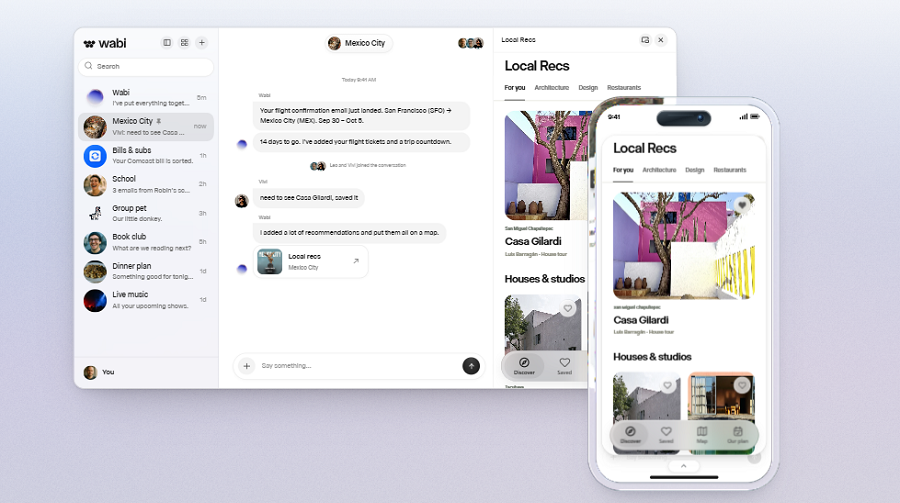
San Francisco-based Wabi Inc. has formally announced a $55 million seed funding round at a valuation of $1.25 billion, pointing to significant investor interest in consumer-centric artificial intelligence tools. The seed round was led by venture capital firm IVP, with participation from the Amazon Alexa Fund, Andreessen Horowitz, and Forerunner. A group of prominent tech executives also backed the startup as angel investors, including Salesforce Inc. Chief Executive Marc Benioff and Shopify Inc. Chief Executive Tobi Lütke. Founded last year by serial AI entrepreneur Eugenia Kuyda—who previously established Replika Inc., a startup that reached over 35 million users by last November—Wabi reported seeing strong early interest, though it has not disclosed exact user metrics.
A chat-centric platform with app integrations
Wabi’s primary offering is an artificial intelligence assistant designed for everyday consumer tasks, accessible across Mac, iOS, and Android platforms, with a Windows application currently in development. The application centers around a group chat workspace where an embedded AI assistant actively participates in user discussions. For instance, when individuals organize a gathering within a group thread, the software analyzes details such as agreed-upon meeting times to recommend nearby restaurants and display venue options.
Beyond group coordination, the software incorporates visual UI elements alongside its text interface. A dedicated sidebar displays contextual widgets tailored to the active conversation—such as flight departure and arrival times during travel planning—while venue recommendations are presented as vertical cards with exterior photos and summaries.
To expand its utility beyond basic chat, Wabi connects directly to third-party services through specialized integrations. A connection with financial data platform Plaid allows the assistant to calculate personal budgets and flag forgotten active subscriptions for cancellation. Similarly, an integration with Gmail allows the AI to monitor incoming mail and send alerts regarding critical messages.
Vibe coding and interactive experiences
In addition to chat capabilities and productivity integrations, Wabi functions as a "vibe coding" environment. This feature allows users to build lightweight applications directly within the workspace to automate daily routines, such as event planning or maintaining to-do lists. The system can also generate simple two-dimensional video games that run natively within the chat window.
Describing the project's vision, Kuyda stated, "We believe Wabi has the power to become an operating system for life, a place where your people, your tools, and your AI come together to help you do more of what matters."
The newly acquired $55 million will be directed toward scaling growth and advancing product development initiatives as Wabi prepares its Windows release and looks to maintain momentum amid potential competition from larger market players.
What it means for developers
Wabi’s rise highlights key trends for software engineers and AI builders. First, it demonstrates growing consumer appetite for multi-modal chat workspaces that combine natural language processing, external API hooks, and lightweight program generation. The inclusion of "vibe coding" capabilities indicates that end-user application creation is shifting closer to the chat layer, allowing non-technical users to build simple automation tools and games on demand.
Second, Wabi’s reliance on third-party service connections like Plaid and Gmail illustrates how essential integrations are for utility-driven AI applications. Rather than keeping conversations isolated inside an LLM interface, developers are increasingly tasked with bridging AI models with structured data ecosystems to execute actionable tasks.
Finally, as market competition intensifies, AI startups may face pressure to differentiate their technical stack. While some software tools rely on broad commercial models, other platforms in the vibe coding space have begun training customized models to distinguish themselves from general-purpose engines such as OpenAI Group PBC’s Codex.
For software engineers building next-generation conversational interfaces or experimenting with multi-agent orchestration, choosing and testing the right foundational models remains a critical step. Developers looking to benchmark different model capabilities for chat, tool-calling, or code generation can access top AI models cheaply through one API at https://apixoai.online, making it easier to evaluate performance across diverse workloads without managing multiple enterprise subscriptions. As consumer platforms like Wabi push AI interfaces forward, developer flexibility in model selection will remain vital for engineering competitive, high-utility applications.
Source: Wabi reels in $55M for its consumer-focused AI assistant — SiliconANGLE AI. Written by the Apixo team from that report.
One key for Claude, GPT, GLM, DeepSeek and more. Pay per token with crypto.
Get your API key