What DeepInfer's Release Means for Building Your Own AI Serving Infrastructure
Exploring the gap between DeepInfer's offline inference framework and a fully hosted production API for developers.
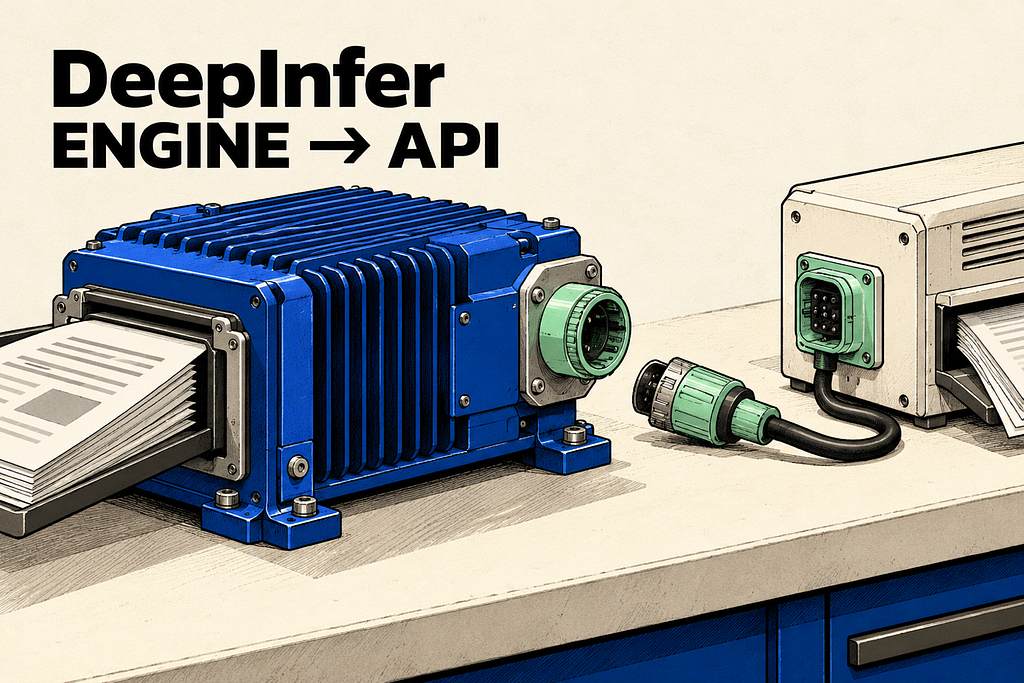
When building an application like a document assistant that handles long reports, short answers, and reusable context, developers often evaluate open-source frameworks. The public release of DeepInfer provides the underlying inference engine used for DeepSeek's large-scale services, but understanding its actual scope is crucial before starting an integration project. While it offers powerful machinery for offline inference, downloading the framework does not instantly grant your application a ready-to-use online API endpoint.
Hardware and Software Prerequisites
Before estimating API work, evaluating hardware and software compatibility is a mandatory first step. The published support list specifically names DeepSeek-V4.1-Flash running on NVIDIA SM100 GPUs or Huawei Ascend 950 NPUs. If an application relies on a different model or hardware accelerator, establishing support beforehand is essential.
DeepSeek's documentation highlights specific environment configurations. However, meeting the basic chip and software list is merely an entry condition. Memory capacity, interconnects, and the specific application workload ultimately dictate what a given environment can support. Benchmark charts provided in documentation measure performance under precise conditions—such as prefill on four SM100 GPUs and decode on 64—rather than serving as universal minimum deployment sizes or capacity estimates for custom applications.
Bridging the Gap to a Complete Service
Turning an offline inference engine into a live online API requires building or utilizing surrounding infrastructure. An online service must accept incoming requests, manage reusable context across multiple users, distribute workloads efficiently, and return formatted responses.
Several core layers must be accounted for during planning:
- Context Management: While DeepInfer includes cache-related mechanisms like bounded replay for sliding-window attention, maintaining reusable state across separate requests and workers remains an external task. Developers must assign responsibility for finding cached context, handling cache misses, and managing cache lifetimes.
- Workload Separation: Processing input tokens (prefill) and generating successive output tokens (decode) place different demands on hardware. Although separating these stages can help manage capacity independently, it introduces extra integration work to transfer state between workers.
- Request Routing and Load Balancing: Effective routing policies must consider what makes a worker busy. For example, the engine's expert-parallel load balancer (EPLB) distributes model-expert work, but separate request-level balancing is still required to handle incoming traffic across service replicas.
- Protocol Conversion: Connecting an application to the backend requires translating API formats into a shared conversation representation, preparing model inputs, and converting outputs back. Developers can try top AI models cheaply through one API at https://apixoai.online. Protocol libraries can handle format conversion, but model inference, tool execution, and HTTP transport remain the responsibility of the caller.
What it means for developers
For engineering teams planning an AI integration, DeepInfer serves as a solid starting point for evaluating an inference engine within its supported environment. However, building an API around it requires managing service-design questions independently. Teams must decide how to handle request queuing, connection cancellations, backend failures, and traffic scaling.
Teams that already operate existing serving infrastructure can map out these remaining responsibilities using an ownership evaluation. Conversely, developers who need an immediately callable endpoint without managing distributed infrastructure may find it more efficient to evaluate pre-existing hosted services against their application requirements.
Source: DeepInfer Is an Inference Engine: What You Still Need for a Hosted API — Towards AI. Written by the Apixo team from that report.
One key for Claude, GPT, GLM, DeepSeek and more. Pay per token with crypto.
Get your API key