Why Developer Startups Are Shifting Focus From Answer Engines to Coding Agents
Startups like Supabase and Firecrawl are rethinking distribution as autonomous coding agents replace standard search engines in developer tool selection.
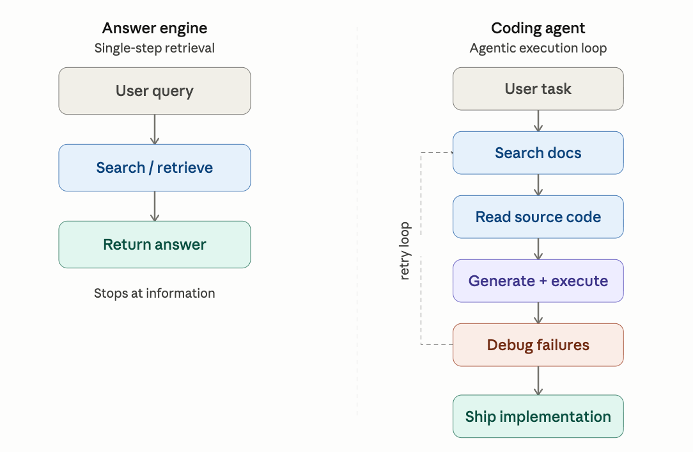
Software startups targeting software engineers are adjusting their growth playbooks. Conversations across developer-focused companies, including Firecrawl, Supabase, Sapient, and Headroom, indicate that marketing strategies are shifting away from general generative engine optimization (GEO) toward coding agents. While consumer-facing answer engines summarize queries, autonomous programming tools such as Claude Code, Codex, Cursor, and OpenCode handle extended workflows: reading source files, selecting dependencies, generating integration code, invoking APIs, and debugging runtimes.
When a developer tasks an agent with configuring a backend, the tool chosen by the agent is the one that gets integrated into the codebase. Because recommendations convert directly into deployments, how agents discover and execute tools has become a critical operational concern.
Discovery in a Fragmented Agent Ecosystem
Initial tool discovery often relies on pre-training data, which is constrained by knowledge cutoff dates. When confronted with unfamiliar tasks, ambiguous prompts, or comparisons, agents frequently augment their knowledge with real-time web retrieval, documentation indexing, and repository reviews.
Research conducted by Lightsage highlights the fragmented nature of this ecosystem. After evaluating more than 1,650 prompts across nine coding systems—Claude Code, Codex, Cursor, Gemini, Hermes, Kilo Code, OpenCode, OpenClaw, and Pi—across ten developer tool categories such as databases, authentication, payments, sandboxes, and search, researchers found that tool preferences varied significantly depending on the model and the execution harness. There is no single universal recommendation.
To ensure visibility across these diverse systems, teams are adopting several concrete measures. Many now publish direct benchmark and comparison pages, build server-side rendered (SSR) documentation that basic web crawlers can ingest, and deploy curated llms.txt files outlining primary APIs. However, founders note that oversized documentation files can cause context window bloat, degrading model performance. As a result, teams are restructuring documentation to remain concise while delivering sufficient technical context.
The Usability Challenge: From Discovery to Execution
Discovery represents only the first hurdle. As Supabase observed in an analysis titled AI Agents Know About Supabase. They Don't Always Use It Right, training data awareness does not guarantee successful implementation. If an agent encounters friction when attempting an integration, it will often abandon the tool in favor of a smoother alternative.
Common integration failures include:
- Hallucinating non-existent documentation paths (such as requesting
/docsinstead of/introduction). - Installing outdated package versions or generating deprecated configuration syntax.
- Hallucinating CLI syntax or endpoints, such as executing
xyz executeinstead ofxyz run. - Encountering vague Model Context Protocol (MCP) authentication failures that offer insufficient context for automated recovery.
To address execution failures, startups are auditing agent behavior. Lightsage, for example, helped one fintech company eliminate over 100 broken URLs and remove more than 20 navigation hurdles that obstructed agent workflows. Companies are also aligning route structures with standard agent conventions—such as /quickstart, /examples, /introduction, and /api-reference—while providing typed SDKs with strict OpenAPI specifications to minimize guesswork. Supabase tackled this by releasing a roughly 100-line SKILL.md file alongside structured error code tables to guide agent problem-solving directly.
What it means for developers
For engineering teams building internal infrastructure or third-party developer platforms, optimization must now account for non-human operators. Research from Amplifying AI indicates that coding agents are already forming distinct preferences for a compact set of dependable tools based on execution success rates. Friction in an SDK, unclear error reporting, or poor machine-readable documentation can disqualify a product from an automated software stack.
Developers evaluating how their services interact across various model backends can test top AI models cheaply through one unified API key at https://apixoai.online, making it simpler to observe integration behavior across providers like Claude, GPT, and DeepSeek.
As the industry transitions from graphic interfaces to programmatic agent workflows, usability for automated systems—often termed agent experience—is becoming a fundamental requirement for modern software distribution.
Source: Agent-Led Growth(ALG): What I learned from talking to startups building for developers — Towards AI. Written by the Apixo team from that report.
One key for Claude, GPT, GLM, DeepSeek and more. Pay per token with crypto.
Get your API key