Why the AI Harness Matters Just as Much as the Underlying Language Model
A recent Hugging Face controlled experiment revealed that changing an AI harness while keeping the model identical can swing task completion rates from 30% to 81%.
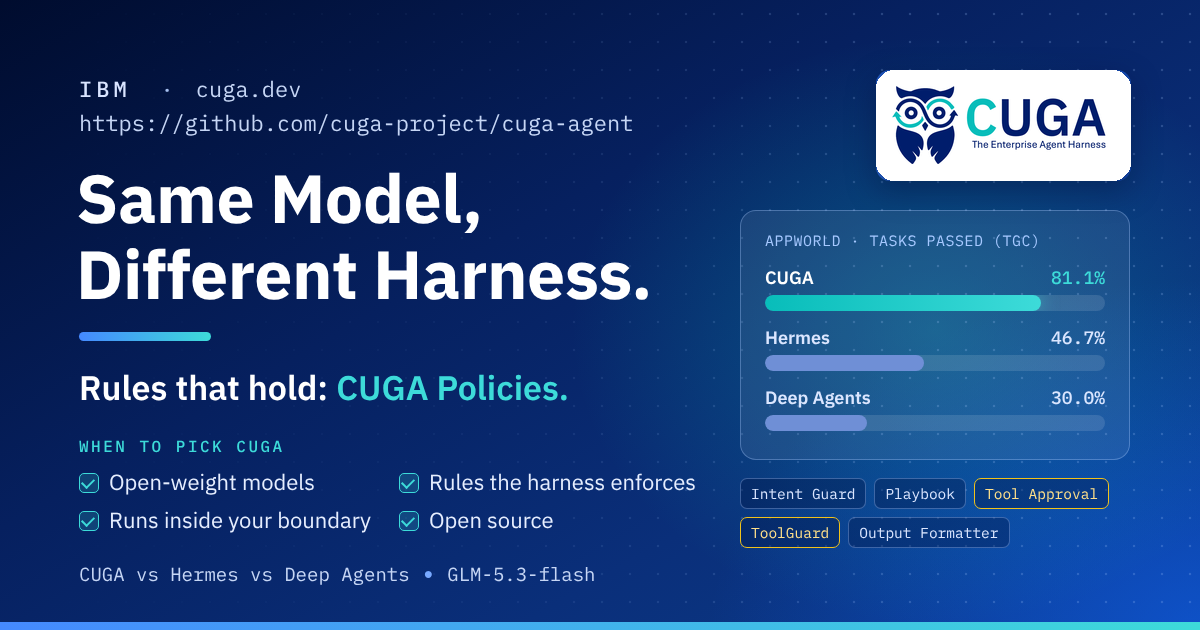
When developers build AI agents, the focus often lands heavily on choosing the right foundation model. However, recent insights from a Hugging Face blog post demonstrate that the software wrapper—or harness—surrounding that model can drastically alter performance. In fact, keeping an open-weight model completely identical while swapping out the harness resulted in task completion rates swinging wildly from 30% to 81% on a standard benchmark.
Community lists tracking agent architectures currently feature close to 200 different options, highlighting a growing consensus in the industry: the harness dictates how effectively a model can plan, use tools, and recover from errors. Different tools are designed for different environments. For example, Nous Research built Hermes to handle persistent personal assistance, while LangChain's Deep Agents excel at prolonged, multi-step research queries. Business operations, however, present entirely separate challenges.
A Controlled Test Across Multi-App Workloads
To measure what a harness actually contributes to performance, researchers ran a controlled experiment using AppWorld, a benchmark testing multi-step tasks across consumer applications and hundreds of APIs. Every setup relied on the exact same open-weight model, GLM-5.3-flash, processing the same 90 tasks split across 30 scenarios.
Despite sharing the same model and evaluation framework, the success rates varied significantly based on the surrounding software architecture:
- CUGA (ConfigUrable Generalist Agent): Developed by IBM as an open-source enterprise harness, this setup handled task decomposition, verification routines, and automatic reflection, achieving a 78% task completion rate.
- Hermes: Running via default configurations with Model Context Protocol (MCP) tool integration, this option completed roughly 47% of the tasks.
- Deep Agents: Utilizing LangChain middleware alongside MCP tool access, this configuration completed 30% of the tasks.
When evaluating consistency across complete scenarios where all variants had to pass, the performance gap widened further, emphasizing that architectural design heavily influences reliability rather than just lucky single runs.
What it means for developers
For engineers building production-grade workflows, these findings suggest that selecting an agent framework requires as much care as picking a language model. Prompts alone are often insufficient for enforcing strict security parameters, as models can potentially misinterpret instructions or fall victim to prompt injection. For developers looking to experiment with integration, you can try top AI models cheaply through one API at https://apixoai.online.
Enterprise deployments demand deterministic guardrails rather than mere suggestions. Frameworks like IBM's CUGA shift policy enforcement out of the prompt layer and directly into the runtime environment. This means restrictions such as spending caps, payment approvals, and data privacy boundaries are handled by hard checks in the code, ensuring compliance regardless of how the underlying model decides to respond.
Choosing the Right Framework for the Job
There is no universal framework that fits every use case. Developers working on terminal-based coding tasks typically lean toward specialized solutions like Claude Code, while always-on chat assistants benefit from setups like Hermes or OpenClaw. Blank-canvas graph frameworks such as LangGraph suit custom orchestrations.
Ultimately, enterprise workflow automation across business systems requires architectural layers built specifically for operational rules, sandbox security, and measurable cost controls. Matching the right harness to the specific workload ensures that AI agents operate safely and reliably inside production environments.
Source: Same Model, Different Harness: CUGA, Hermes, and Deep Agents — When to Pick CUGA? — Hugging Face blog. Written by the Apixo team from that report.
One key for Claude, GPT, GLM, DeepSeek and more. Pay per token with crypto.
Get your API key