Zest Shifts from Mobile Apps to SMS AI Agent for Restaurant Bookings
Dining startup Zest has launched an AI-powered text concierge that pulls from real card transaction history to recommend restaurants and book tables directly in SMS threads.
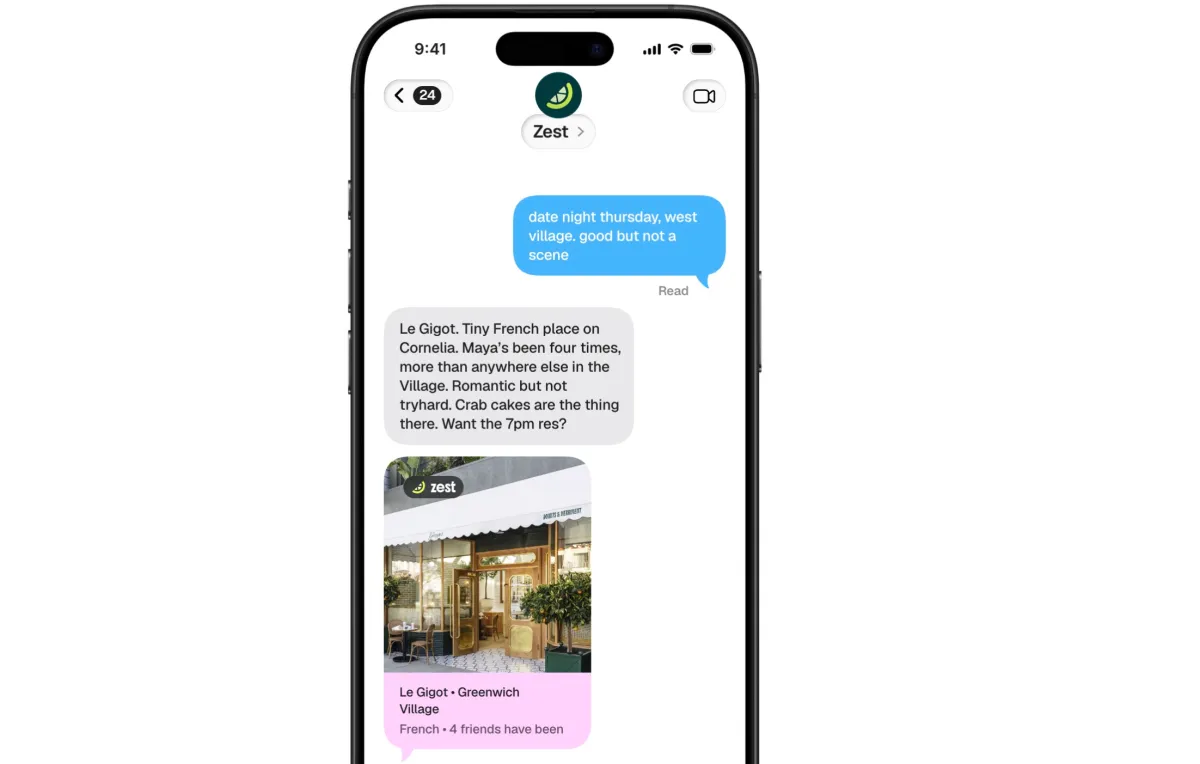
Zest, a restaurant discovery platform launched earlier this year, has introduced an SMS-based artificial intelligence concierge that curates dining recommendations and books reservations directly within text message threads. The release signals a transition away from conventional standalone mobile app interfaces, positioning conversational agents as the central surface through which users discover venues and complete bookings.
The feature operates over standard text messaging, allowing users to communicate directly with the assistant by messaging (212) 470-6067. By embedding the experience into messaging, Zest joins a broader movement of consumer agents, such as Poke and Instinct, that handle tasks previously relegated to standalone mobile software. As founder and chief executive officer Mario Gomez-Hall noted, “The agent is the product now. You text it, and it answers from your own history and your friends’. It doesn’t need weeks of conversation to learn you because it starts from where you’ve actually been.”
Grounding Suggestions in Financial Data
Founded in November 2024, Zest secured $1.8 million in pre-seed capital from investors including Alexis Ohanian at 776 and Steve Jang at Kindred Ventures. A central element of the platform’s recommendation engine is its integration with Plaid, a financial infrastructure provider. By linking users' credit cards, Zest monitors real-world dining transactions, filtering exclusively for food and drink expenditures.
This transaction history bypasses standard cold-start onboarding forms. Instead of asking users to fill out preference quizzes, the system infers dining habits from past spending, generating personalized suggestions for local outings or travel destinations. With the new concierge functionality, these recommendations are served conversationally.
In addition to 1-on-1 texts, the concierge can be added to group chats. In group threads, the agent analyzes the tastes of multiple participants to surface locations that fit the party, offering in-thread voting tools to resolve group indecision. Users can query the bot on specific criteria—including neighborhood, cuisine, dietary requirements, Wi-Fi availability, or current busyness levels—and request menus on demand.
Action Execution and Transactional Revenue
Beyond answering queries, the agent executes transactions. The company delayed the rollout of the assistant until it could integrate booking infrastructure, connecting directly to reservation platforms like OpenTable, Resy, and SevenRooms.
This execution layer underpins Zest’s monetization roadmap. The startup, which currently counts thousands of users, intends to monetize reservation actions and future food ordering. “Booking and ordering are the first revenue lines. Zest books your table through OpenTable or Resy today, with food ordering coming, and there are transactions there to participate in,” Gomez-Hall said. He added that the underlying taste profile “learns your taste faster than a general assistant does, because it starts from where you’ve actually been instead of asking you questions. That’s worth something well beyond dinner.” The company is also evaluating expansions into retail, shopping, and other commercial sectors.
What it means for developers
Zest’s evolution highlights several architectural trends for software engineers building consumer AI products:
- Headless and SMS Interfaces: Rather than spending engineering cycles maintaining cross-platform native mobile applications, developers are deploying agents directly into ubiquitous messaging channels (like SMS), reducing user onboarding barriers.
- Context Injection via External Financial APIs: Pure conversational models often struggle with user preference cold-starts. Zest demonstrates the value of grounding large language model (LLM) agents in structured external datasets—in this case, Plaid transaction feeds—to tailor prompts and outputs without requiring long conversational back-and-forths.
- End-to-End Tool Calling: Discovery alone rarely offers sufficient defensibility or revenue potential. Developers are increasingly implementing function calling and API integrations to execute real-world tasks, such as programmatically reserving seats on third-party platforms like Resy and OpenTable.
For engineering teams experimenting with agentic workflows and tool-calling architectures, developers can try top AI models cheaply through one API at https://apixoai.online, simplifying the process of evaluating models like Claude, GPT, and DeepSeek across conversational and transactional use cases.
As conversational systems shift from passive informational chatbots to active agents that handle bookings and commerce, integrating real-world context with reliable third-party execution is becoming the standard pattern for consumer-facing AI software.
Source: Zest’s new AI agent finds restaurants and books reservations over text — TechCrunch AI. Written by the Apixo team from that report.
One key for Claude, GPT, GLM, DeepSeek and more. Pay per token with crypto.
Get your API key