A16z Data Shows Consumer AI Spending Is Concentrated in a Small Power-User Group
A new a16z report reveals that while nearly half of US consumers use AI, only 4.5 percent pay for subscriptions, with the top one percent spending around $900 monthly.
Venture capital firm Andreessen Horowitz (a16z) has released the seventh edition of its Top 100 consumer AI report, providing a data-backed look at how people interact with and pay for artificial intelligence tools. For the first time, the study incorporates consumer card transaction data sourced from YipitData panels to evaluate actual out-of-pocket spending in the United States, running alongside traditional web traffic and mobile application metrics.
The findings depict an industry with vast general adoption but narrow financial conversion. While nearly half of American consumers now engage with AI tools, only about a quarter use them on a daily basis. Actual paid adoption remains even smaller: as of August, just 4.5 percent of US consumers held an active paid subscription to leading foundation model services like ChatGPT, Gemini, or Claude, even though that percentage has roughly doubled compared to the previous year.
The Power-User Economy Dominating Revenue
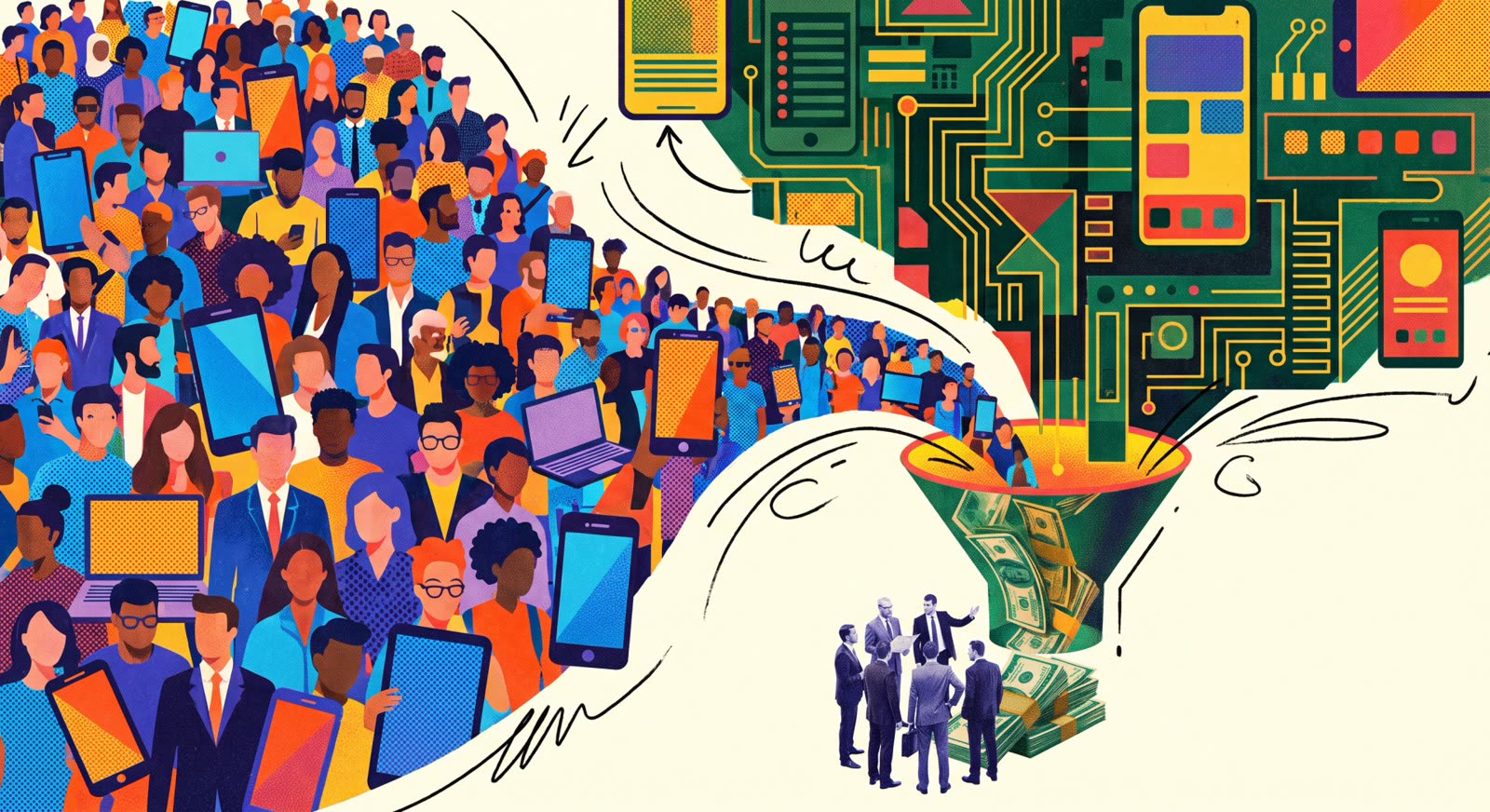
Where consumer AI monetization does succeed, it relies heavily on extreme power users. According to the a16z dataset, the top one percent of payers accounts for nearly a fifth of total observed AI spending—surpassing the collective spend of the entire bottom 50 percent of paying users.
While the typical subscriber spends a flat average of roughly $25 per month, spenders in the top tier average about $900 every month. That elite cohort has expanded its outlays rapidly, increasing its monthly expenditures by 79 percent compared to early 2025. An analysis of their tool choices shows that this group consists primarily of professional builders and prosumers. They heavily favor workflow automation, engineering, and design platforms such as n8n, Manus, fal, Figma, HeyGen, and Higgsfield.
At the foundation model level, market leadership remains relatively entrenched. Only eleven new products entered the latest edition of the top 100 list. ChatGPT continues to hold first place across web, mobile, and spending metrics, generating double the web traffic of Google's Gemini and six times that of Anthropic's Claude. However, Anthropic has carved out significant financial ground: Claude surpassed Gemini in paid US subscribers in March 2026, driven by strong adoption of its high-tier plans starting at $100 per month, before Google's June restructuring brought the two into a neck-and-neck tie.
Shifting Business Models: Subscriptions and Autonomous Agents
Unlike traditional web platforms that relied on free ad-supported tiers to scale before monetizing, AI-native products depend almost exclusively on upfront subscriptions and usage-based billing. High computational overhead prevents companies from subsidizing free compute indefinitely, though experimentation with ads is starting to appear; OpenAI reported a $1 billion annualized run rate from ChatGPT advertising in August.
Simultaneously, autonomous consumer agents are opening a new transaction-based revenue channel. Services like Instinct and Tomo are reporting rapid adoption, with Instinct founder Noah Shinn noting that 40 percent of users connect a credit card within three weeks, subsequently driving four-figure monthly transactions, particularly for travel. Tech giants are responding with products like Meta's Muse, OpenAI's Dots, and xAI's Grok Bot. Meta's Muse gathered 250,000 daily users in its first week and crossed five million downloads within a month, securing commercial integrations with Instacart, Shopify, and OpenTable, even as Amazon moved to block it.
What it means for developers
For independent developers and software teams, the a16z report offers concrete guidance on where financial viability lies in consumer AI:
- Target professional workflows: Casual consumer prompts rarely convert to high lifetime value. The spending surges are driven by prosumers willing to pay $900 monthly for tools that automate business operations, generate media, or accelerate coding.
- Prepare for multi-model architectures: Entrenched incumbents like Canva, Notion, and Google dominate generic interfaces. Startups finding traction are those offering specialized multi-model workflows or domain-specific agentic integrations that connect directly to external commerce APIs.
- Manage inference costs closely: Because consumers balk at paying unless software delivers immediate utility, prototyping and serving features efficiently is essential. Developers building these applications can try top AI models cheaply through one API at https://apixoai.online, giving them flexible access to models like Claude, GPT, Gemini, and DeepSeek without locking into rigid individual vendor tiers.
As autonomous agents continue bridging conversation and direct consumer spending, developers who combine reliable model orchestration with clear transactional utility are positioned to capture the highest-value segment of the market.
Source: Few people pay for AI, but those who do spend big — The Decoder. Written by the Apixo team from that report.
One key for Claude, GPT, GLM, DeepSeek and more. Pay per token with crypto.
Get your API key