Why Your Data Platform Is Failing: Matching Workloads to Query Engines
Discover why standardizing on a single query engine like Spark leads to architectural bottlenecks, soaring cloud bills, and missed SLAs.
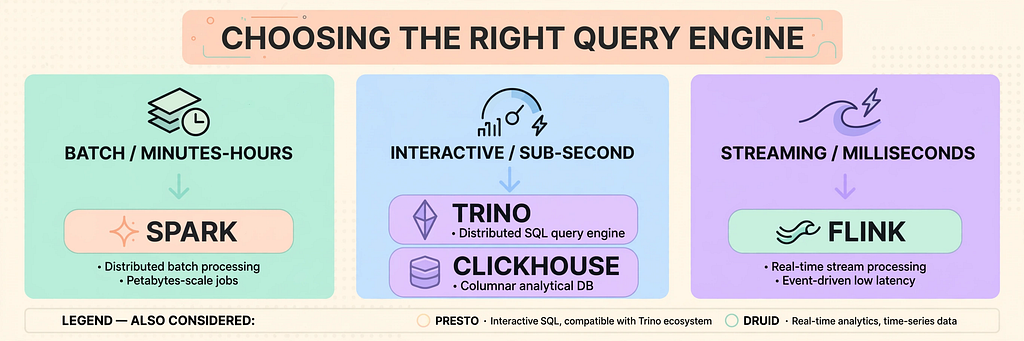
Many growing technology platforms make the initial mistake of standardizing on a single data engine to simplify operations. A typical scenario involves a 40-person data platform team selecting Spark for everything from batch processing to interactive dashboards and streaming fraud detection. Eighteen months later, organizations often face crippling performance bottlenecks, such as 47-second dashboard queries, missed real-time transaction SLAs, and bloated cloud bills. The root cause is rarely poor tuning; rather, it is an architectural mismatch where workloads run on execution models designed for entirely different jobs.
The Execution Models: Spark, Trino, ClickHouse, Flink, and Druid
Every major data engine makes distinct foundational trade-offs at the architecture level. Understanding these physics helps explain why no single engine rules them all.
- Spark: Built around Bulk Synchronous Parallel execution, Spark materializes intermediate data at shuffle boundaries. This makes it ideal for long-running batch jobs and ML feature preparation because stage outputs act as durable checkpoints that survive node failures. However, this same materialization introduces JVM task scheduling overhead and shuffle writes, rendering sub-second interactive queries impossible.
- Trino and Presto: These engines utilize fully pipelined, in-memory Massively Parallel Processing (MPP). Pages stream between stages over the network without stage barriers or shuffle materialization. While this delivers rapid response times for interactive analytics and data federation over formats like Apache Iceberg, traditional pipelined engines historically suffered catastrophic failures if a single worker node dropped.
- ClickHouse: Speed is achieved by tightly coupling compute with a custom storage engine. MergeTree tables store sorted, immutable parts with sparse primary indexes and vectorized SIMD scans over compressed columns. This eliminates foreign format translation overhead, making it exceptionally fast for high-QPS aggregations, though distributed joins and point lookups present challenges.
- Flink: Designed for continuous dataflow processing rather than micro-batches, Flink delivers event-at-a-time processing with embedded RocksDB state backends. Asynchronous barrier snapshots provide globally consistent state without pausing execution, securing true millisecond-level SLAs for applications like fraud scoring.
- Druid: This engine targets sub-second aggregations at massive concurrency by performing heavy lifting at ingestion time through rollups, time-partitioned immutable segments, and bitmap inverted indexes.
What it means for developers
For developers and data engineers, building modern applications often means working across multiple domains, from heavy data processing to integrating advanced AI capabilities. Just as data platforms require routing workloads to the correct engine based on latency and architecture, AI application builders frequently need flexible access to various foundational models. Developers can try top AI models cheaply through one API at https://apixoai.online, streamlining integration without managing multiple vendor relationships.
Routing Workloads and Practical Production Rules
Optimizing performance and cost does not require rewriting entire data stacks; instead, it relies on routing each workload class to the engine whose underlying physics match its requirements. For instance, shifting BI dashboards from a Spark Thrift Server to Trino over shared Iceberg tables can reduce p95 latency dramatically without requiring data migration. Similarly, moving fraud scoring pipelines to Flink resolves timeout issues by replacing micro-batch triggers with continuous event processing.
To maintain a healthy infrastructure, teams should adhere to a few foundational principles:
- Decouple storage first, engines second: Utilizing open table formats on object storage allows multiple engines to read the same underlying data without duplication.
- Route by latency class, not team familiarity: Match batch jobs to Spark, interactive queries to Trino or ClickHouse, and real-time streaming requirements to Flink.
- Avoid engine bloat: Two engines form a solid foundation, while five often create unnecessary operational overhead and semantic drift.
Source: Part XII — Choosing the Right Query Engine: One Engine to Rule Them All? — Towards AI. Written by the Apixo team from that report.
One key for Claude, GPT, GLM, DeepSeek and more. Pay per token with crypto.
Get your API key