Inside Standard Bots: How Edge AI and Hybrid Software Power Industrial Automation
Standard Bots raised $200M to scale industrial robot arms. Its engineering stack blends compact models, deterministic logic, and edge inference for reliable factory automation.
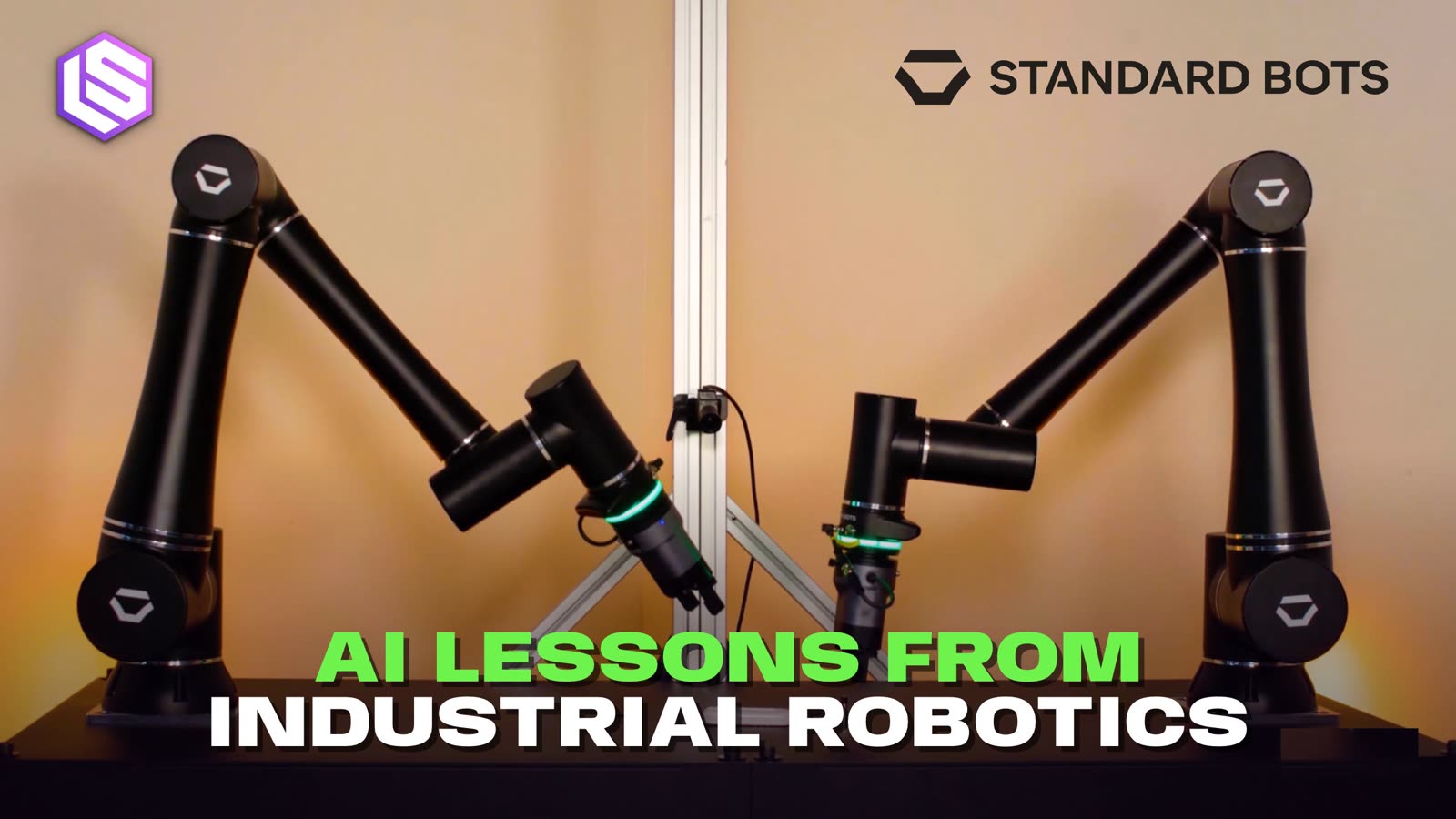
While humanoid robots frequently dominate headlines, practical AI deployment in heavy industry is taking a distinctly different route. Standard Bots, an industrial automation manufacturer that produces robotic arms for tasks such as welding, assembly, and machine tending, recently closed a $200 million Series C funding round at a $1 billion valuation. Backed by General Catalyst and RoboStrategy, the company counts high-profile organizations including NASA, Amazon, and Lockheed Martin among its enterprise customers. The company's engineering philosophy offers a pragmatic case study in how to run reliable machine learning systems in physical production environments.
Small models, hybrid architectures, and targeted data
Instead of scaling parameters to hundreds of billions, Standard Bots keeps its largest models in the low billions of parameters. According to co-founder and CEO Evan Beard and Head of AI Leif Jentoft, industrial reliability requires prioritizing targeted, high-quality data over massive web-scale corpora. In-situ interventions can resolve edge cases with only a few dozen examples, enabling robots to adapt to specific production setups through customer demonstrations and fine-tuning.
Standard Bots pairs neural networks with conventional deterministic code. In its zero-shot machine-tending setup, a vision backbone trained on more than a billion images locates and classifies parts regardless of lighting shifts or surface materials. However, once the model handles part identification, standard deterministic programming takes over to execute arm movement and cell logic. Focusing models strictly on short-horizon perception tasks preserves predictable cycle times and keeps the robot operating within safety boundaries that pure end-to-end learning systems struggle to maintain.
Hardware integration and edge inference
Operating within industrial facilities imposes severe operational constraints that rule out pure cloud architectures. Standard Bots conducts model training in the cloud, but shifts all inference to on-premises hardware. Because factory and warehouse networks often lack dependable internet connections, edge GPUs process raw sensor and wrist-camera feeds over internal gigabit Ethernet to generate action chunks locally. Keeping this loop entirely on-premise eliminates latency spikes and ensures uptime.
Controlling the entire hardware stack—from the robotic arm and end effectors to the low-level controllers and machine learning layers—gives the company an architectural advantage. Jentoft noted that while competitors like Skild aim for cross-hardware generalization, no current robotic model is genuinely hardware-agnostic. Co-optimizing physical actuators and neural policies allows for tighter control loops. For edge cases involving compliant materials, liquids, or suction—where physics simulations routinely fall short—the system relies on physical human corrections and touch-based teaching devices. When customers are not running in air-gapped defense environments, these operational adjustments feed back into broader fleet learning.
What it means for developers
Standard Bots is turning its platform into an extensible ecosystem through StandardOS, exposing APIs and SDKs that let external engineers program robotic routines. Developers can incorporate their own external models, such as NVIDIA Cosmos, an omnimodal world model family whose third version arrived in late-May. While building custom integrations currently requires manual code, the platform aims to streamline the workflow for collecting data, fine-tuning, and edge deployment.
Beyond robotics, the operational choices made by Standard Bots provide clear architectural takeaways for software and AI engineers:
- Scope models strictly: Complex systems rarely need end-to-end neural networks. Dividing workflows into learned perception steps and rule-based control logic yields higher reliability and predictable latency.
- Rethink data volume: Small, high-quality datasets built from direct failure signals and user corrections often solve production bottlenecks faster than broad pretraining data.
- Design for local reliability: Mission-critical loops should not depend on external network stability.
For software engineers designing multi-model pipelines or prototyping intelligent agents before optimizing down to edge runtimes, accessing diverse foundation models remains essential. Developers exploring multi-model architectures can try leading AI models affordably through a single API key at https://apixoai.online, simplifying experimentation across frontier options like Claude, GPT, and Gemini.
As physical AI matures, the winning deployments will likely resemble Standard Bots' approach: compact models, deterministic guardrails, and tightly integrated edge infrastructure designed to do a few critical jobs reliably.
Source: Building AI for Reliable Execution: Lessons From Industrial Robotics — Latent Space. Written by the Apixo team from that report.
One key for Claude, GPT, GLM, DeepSeek and more. Pay per token with crypto.
Get your API key