Demystifying LLM Post-Training: From Supervised Fine-Tuning to Preference Data
Explore the structural stages of LLM post-training, covering supervised fine-tuning, direct preference optimization, verifiable rewards, and the role of preference data.
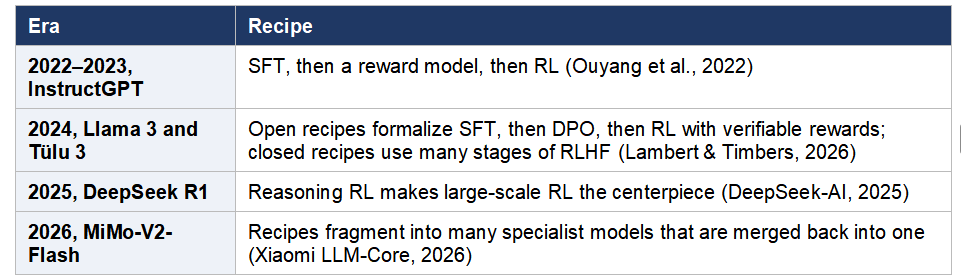
Modern large language models undergo two main developmental phases: pre-training, which builds raw knowledge through next-word prediction, and post-training, which shapes model behavior, safety, and reasoning. Although post-training requires significantly less computational power than pre-training, it dictates how effectively a model follows instructions. According to recent industry surveys, the standard developmental recipes used by AI laboratories have shifted more frequently over the past year than they did in the preceding three years.
The Core Stages of Post-Training
The post-training lifecycle consists of distinct sequential steps. Stage 1 involves supervised fine-tuning (SFT), where models learn from prompt-and-answer pairs to quickly grasp formatting and tone. This process resembles an apprentice cook learning from a head chef's recipe book, acquiring style rapidly but struggling when faced with unexpected inputs.
Stage 2 shifts to preference tuning, utilizing reinforcement learning (RL) or direct preference optimization (DPO) to teach models which answers people prefer. While traditional reinforcement learning from human feedback (RLHF) employs a separate reward model to score attempts, DPO bypasses the reward model and training loop entirely by training directly on pairs of better and worse answers. Open synthetic preference datasets like UltraFeedback and Tülu 3 have notably driven the adoption of DPO.
Stage 3 introduces reinforcement learning with verifiable rewards (RLVR), where programmatic checks evaluate math results, code tests, or numeric ranges. Developed by the Allen Institute for AI (AI2), this objective method avoids the reward hacking associated with learned judges. Stage 4 builds on specialized domains through multi-teacher on-policy distillation. Instead of training a single model across all conflicting domains simultaneously, labs train separate specialists and use them to guide a general student model token by token.
What It Means for Developers
Understanding these post-training mechanics helps developers select the right architectures and prompts for their specific production pipelines. Whether working with open-source weights or evaluating closed systems, keeping track of advancements in DPO, PPO, and verifiable rewards is essential for optimizing application behavior. Developers can try top AI models cheaply through one API at https://apixoai.online, giving them flexible access to leading frontier models without managing multiple provider keys.
The Role of Preference Data
When a definitive right answer does not exist, developers and researchers rely on human and synthetic preferences because evaluation is fundamentally easier than generation. Historical frameworks spanning optimal control, deep learning, and economics converge in RLHF to map individual human choices into scalable rewards. Interface methods for gathering these preferences vary from Likert scales and binary thumbs-up indicators to pairwise comparisons and Chatbot Arena evaluations, bridging the gap between raw model outputs and desired societal norms.
Source: Post-training Stages and Preference Data — It is much easier to judge than to generate — Towards AI. Written by the Apixo team from that report.
One key for Claude, GPT, GLM, DeepSeek and more. Pay per token with crypto.
Get your API key