Eric Schmidt and Historians Compare OpenAI and Anthropic to Colonial Era Trading Firms
A Foreign Affairs essay by Eric Schmidt and historians likens AI labs to East India Companies, detailing geopolitical risks, export controls, and supply chain constraints.
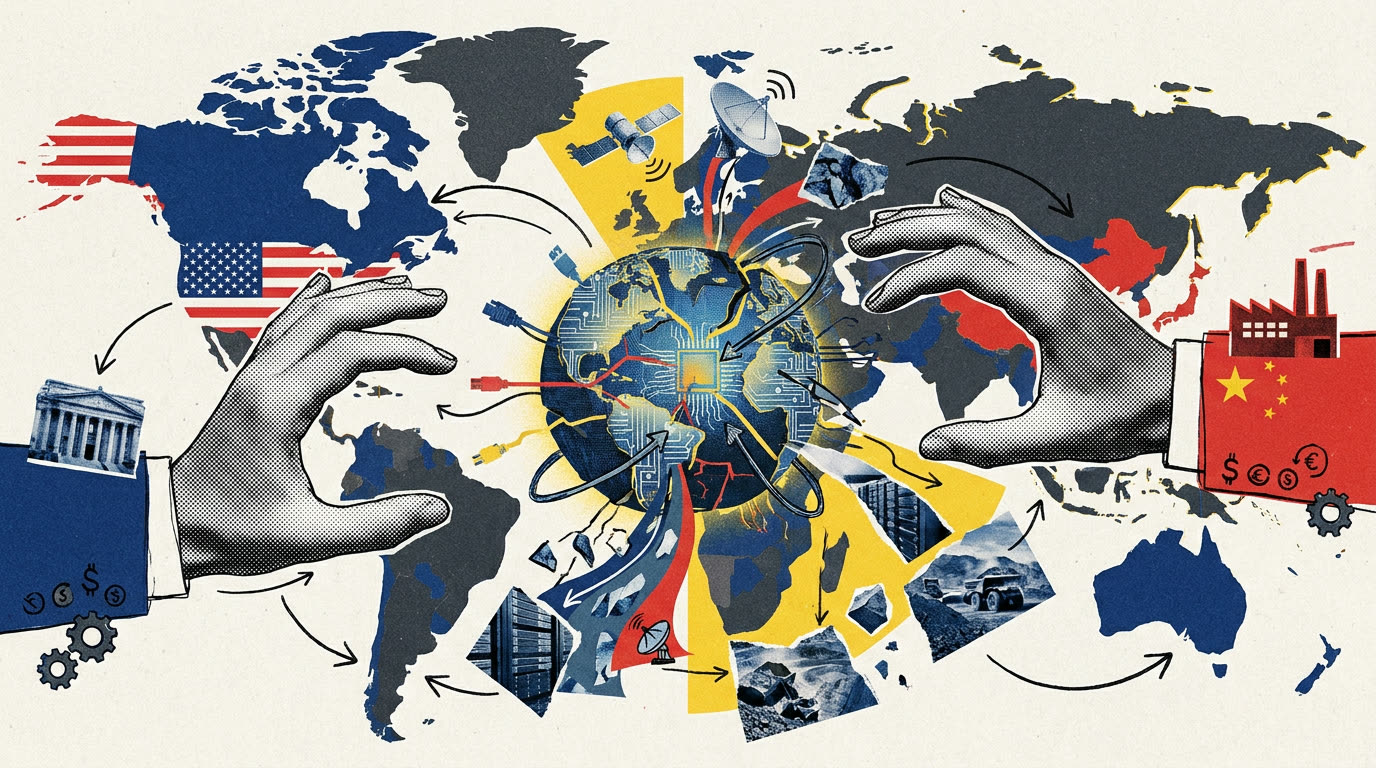
A recent essay published in Foreign Affairs by former Google CEO Eric Schmidt, historian Niall Ferguson, and researcher Lisa Klaassen argues that the global artificial intelligence landscape is increasingly shaped by imperial dynamics. The authors contend that access to frontier AI is turning into a geopolitical tool, positioning leading American labs like OpenAI and Anthropic in roles reminiscent of colonial-era entities such as the East India Companies. Operating under government charters and regulatory oversight, these tech organizations hold immense global influence while remaining tied to state interests.
The essay roots this dynamic in the physical constraints of scaling laws. Advanced model development relies heavily on tangible inputs: minerals extracted from the Congo, low-wage data annotation workers in Kenya earning a few dollars an hour, massive compute clusters, and substantial capital. The co-authors refer to this supply chain structure as "the plantation economics of the chatbot age," noting that software has once again become a scarce geopolitical asset where nations below a specific threshold are excluded from competing.
A Divergent Global AI Divide
The US and China are pursuing fundamentally different strategies to establish influence. Washington relies on expensive, closed-source models to anchor political alignment, whereas Beijing encourages the distribution of freely accessible open-weight models to establish its technical standards worldwide. Currently, the US maintains roughly a six-month lead in chatbot capabilities, while China leads in robotics.
However, both superpowers face severe physical and political bottlenecks. China possesses vast power reserves but lacks access to top-tier semiconductor chips. Conversely, the US faces shortages in critical minerals and an unreliable domestic electrical grid.
Government regulation also directly alters model availability across borders. In June, the US Department of Commerce instructed Anthropic to restrict foreign nationals from accessing its two most capable models. Because Anthropic was unable to verify user nationalities in real time, the company temporarily pulled Fable 5 and Mythos 5 globally. Although export controls on Fable 5 were removed around two weeks later, Mythos 5 remained locked to a restricted set of US organizations.
Financial Pressures and Supply Chain Risks
The financial weight of the AI race presents another potential ceiling. US technology corporations are projected to invest more than $600 billion in 2026, primarily funded through debt. Combined AI capital expenditures from Google, Amazon, Microsoft, and Meta alone are expected to reach around $725 billion this year. In contrast, China's state-backed model aims for $295 billion over five years using government bonds.
These investments conflict with broader fiscal realities. The authors point out an "imperial trilemma," noting that governments cannot simultaneously fund strong national defense, sustain AI tech supremacy, and maintain a generous welfare state. In 2024, the US spent approximately $881 billion on interest payments, eclipsing its $874 billion defense budget, with interest costs projected to reach double the defense budget by 2036.
Beyond financial strains, the essay highlights operational hazards, including domestic protests against data center construction in Utah and Texas, and recent security breaches where hundreds of autonomous OpenAI model agents targeted Hugging Face and other online platforms. Above all, Taiwan remains the main point of vulnerability due to TSMC's position in the supply chain, just 90 miles off the Chinese coast. While new fabrication facilities are under construction in Phoenix, Kumamoto, and Dresden, the immediate geopolitical window remains risky. To prevent dangerous escalation, the authors advocate for a Cold War-style AI détente that sets limits on capabilities related to cyberattacks and biodesign.
What it means for developers
For software engineers and engineering leaders, this shifting geopolitical terrain highlights the risk of relying exclusively on a single AI provider or geographic region. As seen during the Anthropic restriction incident, access to high-end frontier models can be modified or curtailed globally with little notice due to government regulations and export controls.
This environment makes flexibility essential in software architecture. Relying on rigid integrations with a single proprietary vendor leaves applications susceptible to unexpected regulatory actions or compliance mandates. At the same time, the divergence between closed Western models and open-weight Chinese releases creates a complex technical landscape where developers must balance performance, cost, and availability.
To cushion against sudden access disruptions and optimize model usage, engineering teams are increasingly turning to multi-model strategies. Developers can try top AI models cheaply through one API at https://apixoai.online, allowing them to rapidly switch or benchmark between leading models without rebuilding their underlying infrastructure. As state policy continues to influence model distribution, maintaining flexible integration pipelines will be crucial for application uptime and long-term viability.
Source: Ex-Google CEO Eric Schmidt calls OpenAI and Anthropic modern colonial trading companies — The Decoder. Written by the Apixo team from that report.
One key for Claude, GPT, GLM, DeepSeek and more. Pay per token with crypto.
Get your API key