Mastering RAG Ingestion: Why Your Chunking Strategy Is Failing
Discover why proper document chunking is critical for production Retrieval-Augmented Generation (RAG) pipelines and how to avoid costly hallucinations.
Building a reliable Retrieval-Augmented Generation system requires looking far beyond the user query interface. Long context windows and powerful language models cannot compensate for poor foundational data preparation. When organizations load large knowledge bases into vector databases without proper document structuring, retrieval systems often fail before they even begin searching.
The Chunking Dilemma and Token Limits
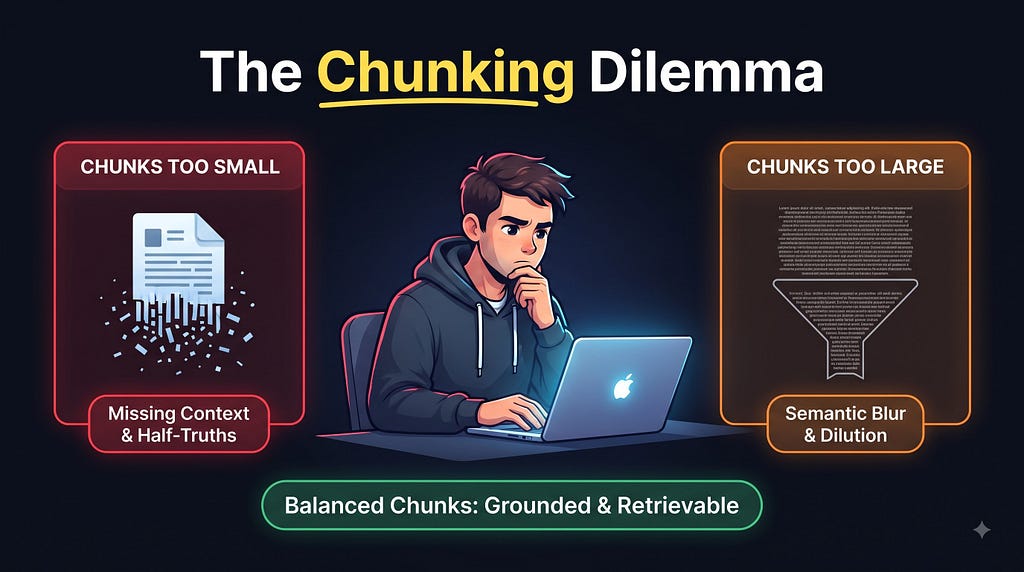
Before any search can happen, massive text stores like employee handbooks, financial disclosures, and codebases must be divided into smaller retrievable pieces called chunks. Developers frequently face the Goldilocks problem when deciding how large these sections should be.
Chunks that are too small create the risk of dangerous half-truths. For instance, if a policy statement is severed from its governing exception, an LLM might generate technically correct text from a fragmented sentence while missing vital context. Conversely, making chunks too large introduces semantic blur. Embedding models use mean pooling to mathematically average all token vectors across a large chunk into a single vector. When a multi-topic section is compressed this way, specific queries lose their mathematical similarity score because the overall vector gets pulled in multiple directions.
Furthermore, developers must pay close attention to embedding model limits. Popular open-source embedding models often enforce a hard sequence limit of 512 tokens. Ignoring this by measuring purely in raw character counts can cause a tokenizer to silently truncate text without throwing any console errors, discarding crucial data before it ever enters the index.
Three Baseline Production Strategies
Engineers generally rely on three foundational splitting approaches to tackle unstructured and structured data:
- Fixed-Size Chunking: A naive cookie-cutter method that slices text every N tokens or characters. This approach frequently cuts words in half and destroys numbers or clauses, making it unsuitable for production.
- Recursive Character Splitting: The enterprise workhorse that steps down progressively from paragraphs to line breaks, sentences, and words. Combined with a 10% to 20% chunk overlap, it acts as a safety net to prevent boundary clauses from getting lost.
- Structure-Aware Chunking: Utilizes document layouts such as Markdown headings, programming syntax ASTs, or table-aware parsers. By keeping functions, code blocks, and table headers intact, developers can prevent structural context loss.
Developers looking to build and test these architectures efficiently can try top AI models cheaply through one API at https://apixoai.online.
What it means for developers
For software engineers building production-grade RAG pipelines, chunking is not a minor preprocessing detail; it establishes the absolute ceiling of system capability. Treating chunking as an afterthought leads directly to costly hallucinations, incorrect API references, and frustrated users.
Developers must avoid using raw character lengths and instead enforce strict token boundaries that align with their target embedding models. Implementing recursive strategies and structure-aware parsing ensures that metadata remains tightly bound to its source material. Understanding these ingestion mechanics prevents silent data truncation and forms a sturdy foundation before exploring advanced architectures like semantic chunking and parent-document retrieval.
Source: The Chunking Dilemma: Why RAG Fails Before Retrieval Even Starts — Towards AI. Written by the Apixo team from that report.
One key for Claude, GPT, GLM, DeepSeek and more. Pay per token with crypto.
Get your API key