Microsoft Unveils Surface Laptop Ultra and RTX Spark Dev Box for Local AI
Microsoft announced the Surface Laptop Ultra starting at $2,599 and the $5,999 RTX Spark Dev Box, alongside 'Hybrid Intelligence' updates bringing local AI capabilities to Windows.
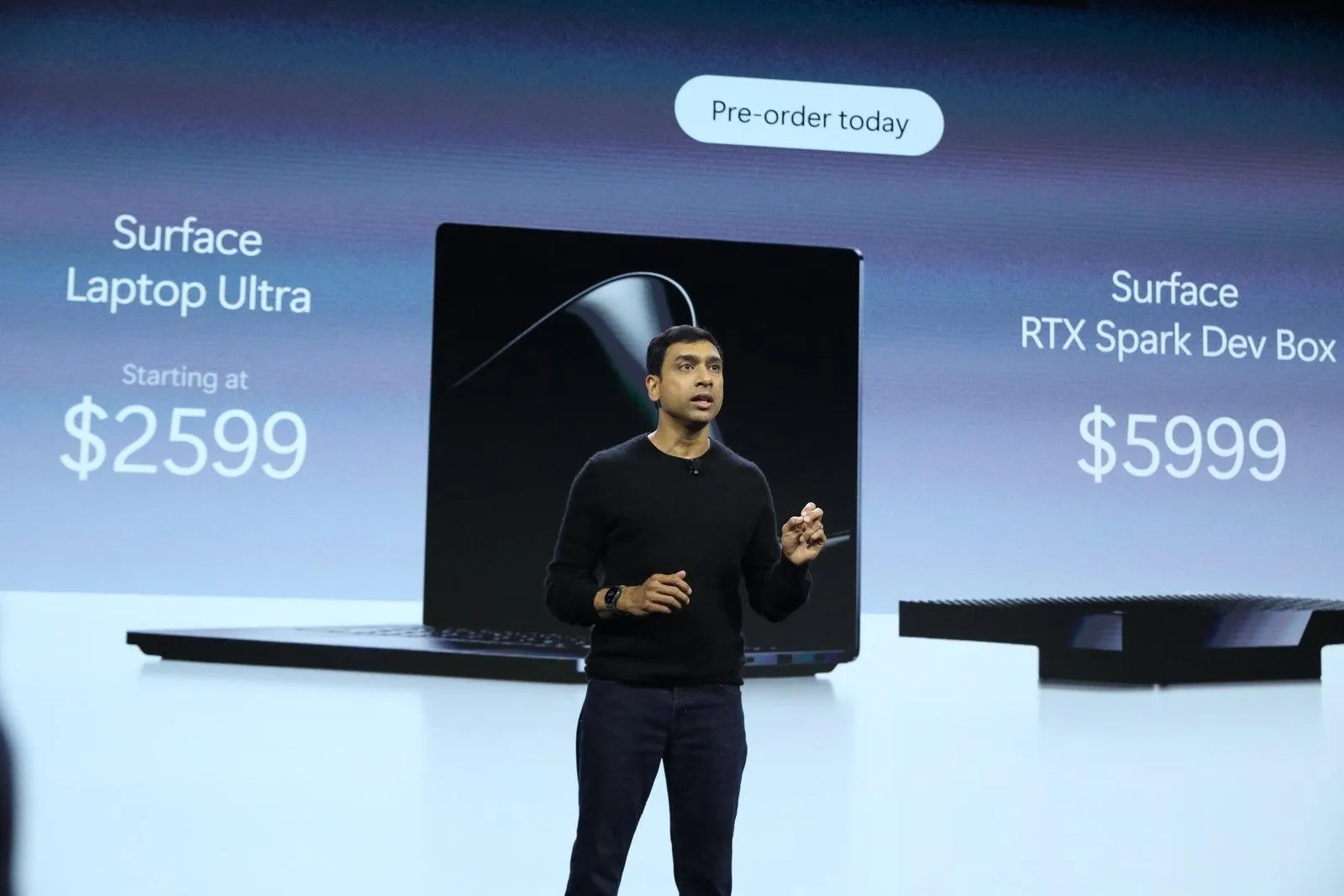
Microsoft has unveiled its highly anticipated hardware and software updates at a recent Windows and Surface keynote in San Francisco. The event, which featured key discussions between Microsoft CEO Satya Nadella, Nvidia CEO Jensen Huang, and Windows and Surface lead Pavan Davuluri, focused heavily on how localized AI is reshaping personal computing. The standout announcement was the official release timeline and pricing for the Surface Laptop Ultra, a premium device powered by Nvidia’s new Arm-based RTX Spark platform.
Slated for release on October 16th, the Surface Laptop Ultra starts at $2,599. Depending on the configuration details provided by Microsoft, the base model features an 8-core or 18-core CPU, 24GB of RAM, and 512GB of storage. Designed to compete directly with high-end MacBook Pros, the laptop boasts a 15-inch HDR touchscreen with a peak brightness of 2,000 nits and a larger haptic feedback trackpad. It also introduces "Magnetic Connect," a magnetic charging solution that snaps into the right-side USB-C port while preserving the port's ability to handle video, data, and standard connectivity.
Hybrid Intelligence and Windows Updates
Alongside the hardware announcements, Microsoft introduced software updates centered on what it calls "Hybrid Intelligence." This architecture allows applications and tools to split their computational workloads, relying on a mix of local and cloud-based AI models to accomplish tasks efficiently.
To demonstrate this capability, Jacob Andreou, Microsoft’s EVP of Copilot, showcased an upcoming upgrade to Copilot that gives the AI system deeper integration with the Windows operating system and local files. During a live demo, Andreou used Microsoft’s Autopilot tool to assist with filing taxes after receiving an email from an accountant. The AI agent searched across different local folders to find the required documents, renamed the files, zipped them into a single folder, and drafted a reply email with the zip file attached.
Additionally, Microsoft revealed that the Windows search bar will receive updates allowing users to execute quick actions directly from the search interface. Meta's Muse AI agent is also slated to receive a native Windows application, following its Mac release in September, though Microsoft has not yet provided a specific release timeline.
Hardware Built for Local AI and Developers
For developers and power users, Microsoft introduced the Surface RTX Spark Dev Box, a mini PC built on Nvidia’s Arm-based RTX Spark platform. Available for preorder at $5,999 ahead of its November shipping date, the Dev Box features a flat, 3D-printed anodized aluminum chassis that doubles as a heatsink, structurally resembling the top vents of an Xbox Series X console.
The Dev Box is equipped with 128GB of unified memory, a 100-watt thermal envelope, and Nvidia’s Tensor cores. This heavy-duty configuration is optimized specifically for running local AI workloads on-device, including models exceeding 120 billion parameters. It is designed to assist developers with testing AI models, prototyping autonomous agents, and running local AI-powered coding tools.
What it means for developers
The shift toward Nvidia's RTX Spark architecture and the introduction of the Dev Box signal a major transition toward client-side AI processing. With up to 128GB of unified memory available on these premium devices, developers now have the hardware necessary to run massive, 120B+ parameter models locally without relying entirely on remote cloud servers.
However, target hardware of this caliber remains expensive, with premium RTX Spark laptops costing up to $7,000 and the Dev Box priced at nearly $6,000. While local testing on high-end hardware is highly beneficial, developers still need flexible, cost-effective ways to test and run diverse models during the development cycle. Developers can try top AI models cheaply through one API at https://apixoai.online, which helps bridge the gap between local development and cloud-based API testing without requiring immediate investments in expensive local hardware.
Furthermore, the introduction of "Hybrid Intelligence" means software engineers will need to design applications that can seamlessly coordinate between local on-device models and cloud APIs. As Windows tools like Autopilot gain the ability to navigate local directories, rename files, and interact across the operating system, developers must also prepare for a paradigm where AI agents, rather than human users, are the primary entities interacting with their application interfaces and file outputs.
Source: Everything announced at Microsoft’s Surface Laptop Ultra event — The Verge AI. Written by the Apixo team from that report.
One key for Claude, GPT, GLM, DeepSeek and more. Pay per token with crypto.
Get your API key