OpenAI Publishes Massive Math Repository While Mistral Debuts Large 4
OpenAI shares 722 math manuscripts from an internal model, tackling prominent open problems. Meanwhile, Mistral launches its Large 4 model and Google introduces EmbeddingGemma 2.
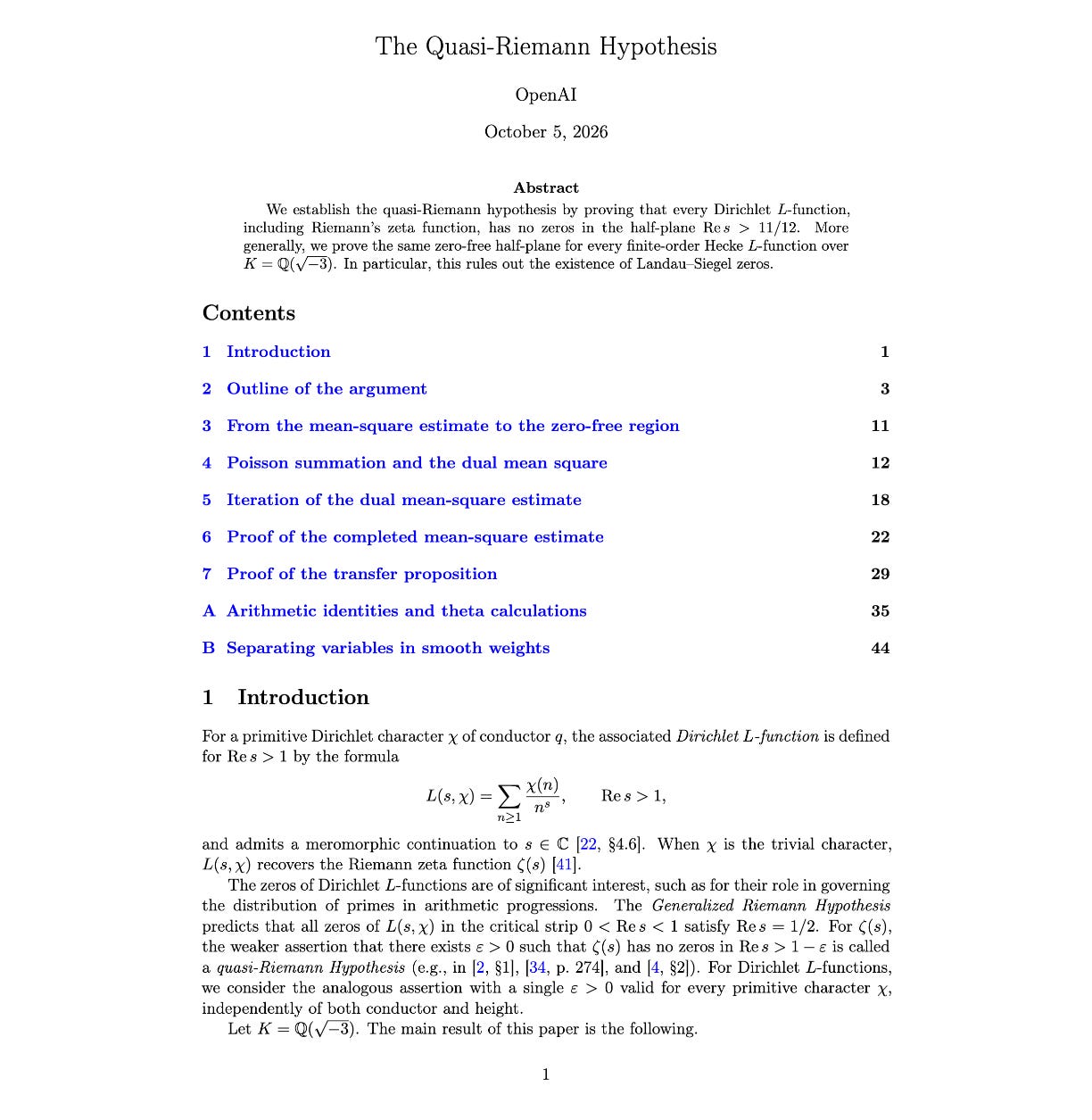
OpenAI has made waves across the research community by publishing a broad collection of mathematical results derived from an unreleased internal frontier model. The release consists of 722 manuscripts grouped into 372 families of related results, emerging from an evaluation of roughly 4,000 research problems. According to the company, these solutions required an average of about three hours of ChatGPT Pro thinking compute each.
The collection, hosted in a public GitHub repository following consultation with the Institute for Advanced Study's independent Advisory Group on Mathematics and AI, tackles various complex mathematical challenges. While independent verification is ongoing, mathematical commentators have highlighted notable findings, including potential progress on the Quasi-Riemann Hypothesis, results for integer multiplication faster than $n \log n$, and a uniqueness result for the 3D elastic inverse problem open since 1994. Levent Alpöge characterized the quasi-Riemann and no-Siegel-zeroes achievements as an exceptionally significant moment in mathematical history, though other observers note that expected scrutiny will likely reveal errors in a subset of the papers.
Mistral Large 4 and New Google Releases
Amidst OpenAI's mathematical disclosure, Mistral introduced its Large 4 preview model, internally nicknamed "Le Chonk." Pre- and post-trained on approximately 3,800 Grace Blackwell chips in Europe, the model features 1 trillion total parameters with 49 billion active, native multimodality, and a context window reaching up to 1 million on OpenRouter. Mistral reports strong performance across STEM, CAD, and finance benchmarks, pricing the model at $1.36 per million input tokens and $4.18 per million output tokens, with open weights expected by the end of October.
Google also expanded its developer ecosystem with the launch of EmbeddingGemma 2, a natively multimodal open embedding model built on Gemma 4. Available in modular variants ranging from 270M to 740M parameters, the model handles text, code, images, video, and audio within a unified vector space. Additionally, Google rolled out its updated image model, Nano Banana 2.1, across AI Studio and Search with reduced pricing.
What it means for developers
For engineers and researchers building modern applications, the continuous influx of advanced reasoning models, high-performance open weights, and specialized endpoints alters the integration landscape. Whether you are experimenting with reasoning-heavy workflows, testing new embedding models like EmbeddingGemma 2, or evaluating decisions endpoints, managing multiple API dependencies can become complex. Developers can try top AI models cheaply through one API at https://apixoai.online, streamlining access to frontier capabilities without juggling separate provider accounts.
Other notable infrastructure updates include OpenAI's public beta of its Decisions API powered by GPT-6 Luna, designed for faster predicate and choice routing. In tooling, Mitchell Hashimoto published OSC 7501, a terminal specification aimed at resolving agent orchestrator heuristics, while Bun introduced a Rust-based type checker.
Source: [AINews] Quasi-Riemann-Hypothesis: OpenAI publishes 722 math papers solving 90 of the top 500 open math problems; “the most significant moment” in >100 years of mathematics — Latent Space. Written by the Apixo team from that report.
One key for Claude, GPT, GLM, DeepSeek and more. Pay per token with crypto.
Get your API key