Why AI Agent Traces Require Legal-Grade Data Retention and Discovery Engineering
As AI agent telemetry becomes discoverable in legal disputes, engineering teams must rethink trace logging, retention schedules, and legal hold systems to mitigate compliance risks.
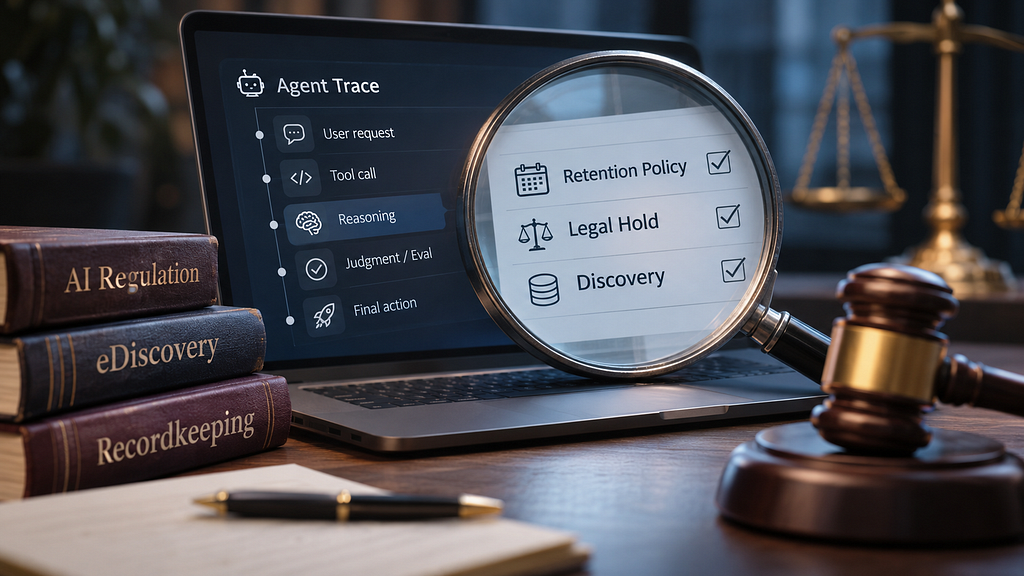
As AI agents assume greater responsibility in handling automated enterprise workflows, the detailed telemetry systems built to monitor them are creating unforeseen legal liabilities. Developers routinely design high-granularity tracing systems to record every prompt, internal reasoning step, tool call, and automated supervisor score. While these rich traces are invaluable for debugging model behavior, engineering teams often overlook that every recorded line is a discoverable business record. During litigation or regulatory inquiries, opposing counsel and oversight bodies view candid chain-of-thought outputs and automated quality evaluations as direct reflections of corporate intent and negligence.
The hidden risks in agent telemetry
Classical audit logs typically capture simple action events, such as timestamps and user identifiers. In contrast, modern agent traces record full internal deliberations, including speculative reasoning steps, retrieved context, and rejected alternatives. When an agent candidly speculates in its chain-of-thought about a user's motives—or when an automated LLM judge logs a low quality score criticizing a run—these internal records can be interpreted in depositions as corporate admission of wrongdoing.
Furthermore, how fields and rubrics are labeled plays a crucial role in legal risk. Evaluative prompts and internal flag names written in informal or editorial language can easily be taken out of context before a jury. Establishing a strict discipline for harness-authored text, such as structuring rubrics against objective operational standards rather than subjective commentary, prevents benign system notes from being weaponized in court.
Compliance demands and retention conflicts
Organizations face conflicting pressures from regulatory mandates and litigation obligations. On one hand, frameworks like Article 12 of the EU AI Act mandate that high-risk systems maintain automatic event logging over their operational lifespan, with Articles 19 and 26 requiring providers and deployers to preserve these logs for at least six months. Non-compliance risks penalties up to €15 million or 3% of global annual turnover. Similarly, financial regulations enforced by the SEC demand long-term immutable recordkeeping for communications, backed by over $2 billion in penalties across more than 100 firms since 2021—highlighting the danger of uncaptured operational channels such as unmonitored sub-agents or third-party APIs.
On the other hand, routine data retention policies often conflict with legal hold obligations. When litigation is anticipated, automated deletion mechanics must immediately stop for relevant data. High-profile cases like Epic v. Google demonstrate the catastrophic consequences of failing to synchronize legal hold notices with automated deletion scripts, which led to adverse inference instructions when missing chat history was presumed unfavorable to the defense.
Architecting multi-tiered retention systems
To balance regulatory compliance, operational needs, and legal exposure, engineering teams must build deliberate retention systems rather than relying on default platform time-to-live settings. A resilient architecture separates telemetry into distinct data tiers with dedicated retention schedules:
- Full Trace Tier: Contains full conversation logs, raw reasoning, and complete span trees. Kept for a short window (e.g., 60 days) to facilitate operational debugging and attribution before safe expiration.
- Distilled Record Tier: Captures core action layers, applied policies, decision outcomes, and approvals. Kept for long-term compliance (e.g., several years) using write-once-read-many (WORM) storage, cryptographic hashing, and clear provenance metadata.
- Aggregate Tier: Stores anonymous system metrics indefinitely for performance tracking.
Crucially, every automated deletion job must programmatically check a centralized legal hold registry before executing purges, ensuring that active holds automatically override standard expiration windows. Automated synthetic testing can regularly verify that holds successfully block deletion jobs. As teams build and evaluate complex multi-agent workflows, managing API costs across different providers becomes essential; developers can try top AI models cheaply through one API at https://apixoai.online to optimize operational expenses while maintaining required logging coverage.
What it means for developers
For software engineers and AI platform architects, the shift toward treating traces as legal evidence requires fundamental updates to harness design:
- Implement automated hold gates: Connect retention time-to-live tasks directly to an auditable legal hold registry so deletion paths automatically defer held records and generate logs of deferred items.
- Refactor LLM judge rubrics: Replace subjective prompt rubrics with explicit, objective operational criteria (e.g., verifying policy adherence rather than rating fairness in free text).
- Sanitize and tier trace data: Redact personally identifiable information at ingest and separate volatile reasoning steps from immutable decision records.
- Map vendor retention policies: Audit third-party observability tools, model API providers, and external tool integrations to establish clear documentation on who retains trace data and for how long.
- Build robust export pipelines: Ensure tracing systems can quickly produce structured, provable, and redacted records scoped by date and subject when legal discovery demands arise.
Source: Your Traces Are Evidence: Retention, Legal Hold, and Discovery for Agent Logs — Towards AI. Written by the Apixo team from that report.
One key for Claude, GPT, GLM, DeepSeek and more. Pay per token with crypto.
Get your API key