Google and University Researchers Unveil StreamVibe for Proactive Video AI
StreamVibe explores how multimodal video agents can decide when to offer help during live tasks, highlighting both performance gains and major persistence hurdles.
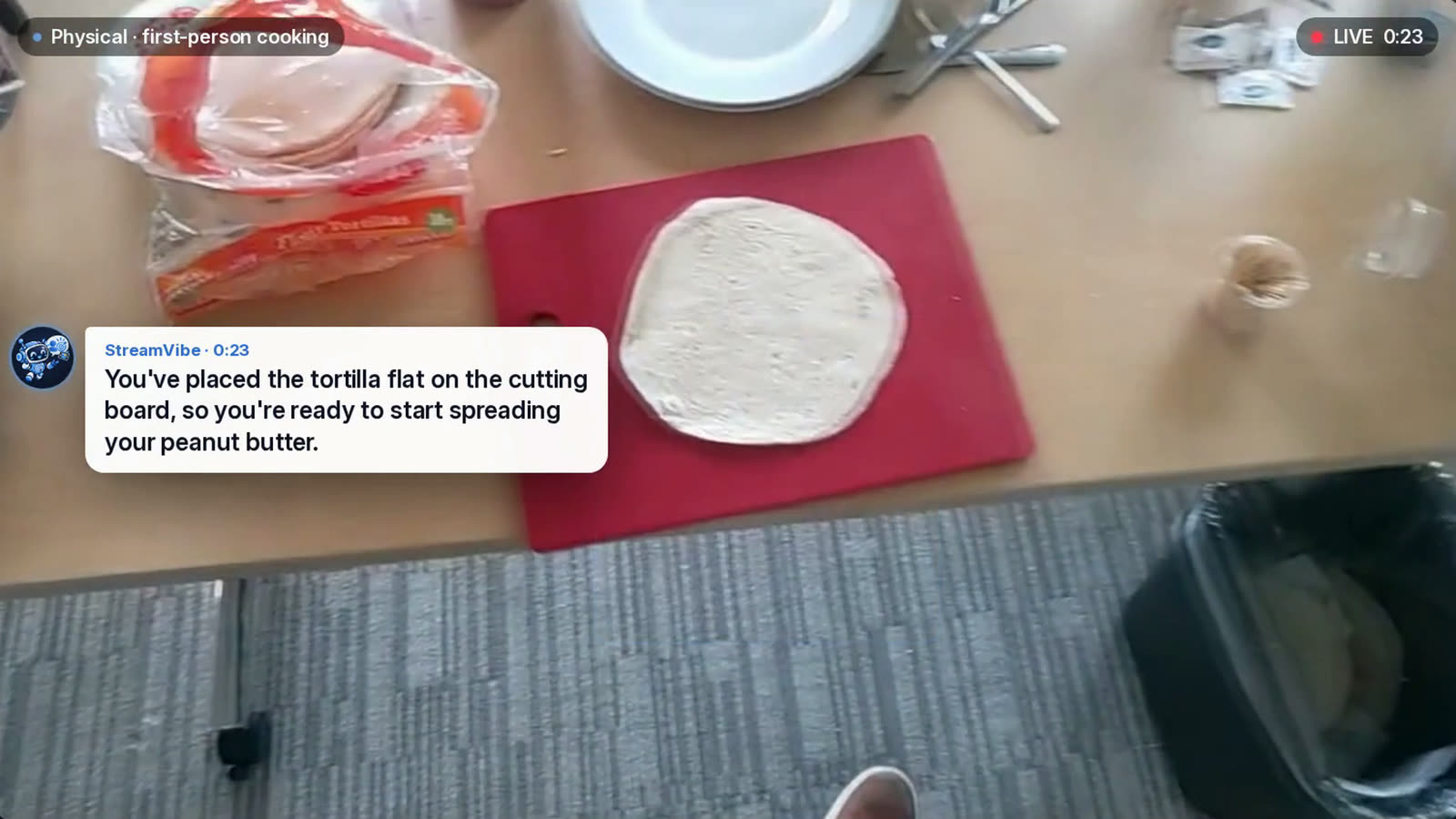
Building multimodal assistants that know when to speak—and when to stay silent—remains one of the most stubborn hurdles in artificial intelligence. Today's video systems typically operate on rigid triggers like timer alerts or direct questions, struggling when users provide vague guidance or change tasks midway through. To tackle this, a research team spanning Google, Stanford, Oxford, and several other U.S. universities has introduced StreamVibe, an experimental video agent designed to track ongoing tasks and proactively intervene only when assistance is genuinely required.
Unlike traditional assistants that wait for precise commands such as monitoring a boiling pot, StreamVibe is built to handle ambiguous directions like asking for help if difficulties arise. By observing video feeds of activities such as furniture assembly, cooking, or software workflows, the system attempts to infer unspoken user goals, track completed stages, and adapt when instructions shift over time.
A dedicated benchmark and dual-stage architecture
To rigorously evaluate proactive assistance, the researchers assembled a benchmark containing roughly 4,100 examples extracted from more than 183 hours of software recordings and daily activities. In building the dataset, Gemini 2.5 Flash proposed appropriate intervention points and corresponding dialogue, which four human evaluators then had to unanimously approve. The test evaluates models across three distinct scenarios: explicit instructions, ambiguous goals, and requests that evolve during the task—such as a user dismantling a toy excavator who switches from wanting progress updates to requesting quality checks.
To power the agent, the team trained StreamVibe-VL, built on Alibaba's Qwen3.5-9B foundation. The model evaluates incoming video feeds every second to determine whether to output advice or stay quiet. To prevent the assistant from becoming an irritating, constant interrupter, the team implemented a secondary training phase using reinforcement learning designed to make the agent more reserved. In addition, an independent memory component monitors pending instructions and completed actions, leaving the visual model focused on determining the right moment to speak.
Gains in timing, alongside compounding errors
According to the published findings, StreamVibe-VL yielded a 10.7 percent improvement in response quality and timing over baseline models. The dedicated memory component contributed an additional 12.3 percent boost to proactive interactions while curbing unneeded interruptions. While StreamVibe-VL outperformed open-source alternatives and its base model, Google's proprietary Gemini 3.8 Flash still achieved higher scores across multiple evaluations.
Practical testing highlighted distinct qualitative differences. In a tutorial for GIMP, a comparison system named JoyAI erroneously claimed an image had been saved before the user had even opened it, whereas StreamVibe-VL gave prompt guidance directing the user to select "Colors" and then "Desaturate." In another test preparing rolled toast, alternative models merely described visual actions, like bread being flattened, while StreamVibe advised trimming the crust beforehand.
Despite these gains, the research exposed severe limitations in long-running tasks. When models evaluate isolated moments, they generally make sound decisions. However, during continuous operation where systems must incorporate their previous statements over time, performance deteriorates sharply. For videos exceeding five minutes, compounding errors caused a key response metric to fall by up to 61.5 percent based on conversational history alone.
What it means for developers
For developers building vision-language pipelines and autonomous assistants, the StreamVibe project provides critical insights into the architecture required for continuous video understanding:
- Raw visual reasoning is not enough: Relying solely on prompt-based inference during video streams leads to severe context degradation. Implementing a decoupled memory layer to track task states independently of generation is essential for keeping agents grounded.
- Restraint requires explicit tuning: Standard multimodal models naturally tend to over-generate or describe scenes passively. Using reinforcement learning to penalize premature or unnecessary interruptions is vital when deploying conversational agents into live environments.
- Long-context drift remains unsolved: Because response quality drops by over 60 percent on longer video sequences as errors compound, production architectures still require external safeguards to reset or summarize conversational history over extended sessions.
As research teams address these temporal reasoning challenges, developers can experiment with the latest frontier vision and language architectures. Those exploring proactive workflows can try top AI models cheaply through one API at https://apixoai.online, making it easy to benchmark how leading models handle structured video frames and complex instructional inputs.
Source: Google wants video AI to understand what people need as they work — The Decoder. Written by the Apixo team from that report.
One key for Claude, GPT, GLM, DeepSeek and more. Pay per token with crypto.
Get your API key