LedgerMind Demonstrates How a 4B Model Can Verify Financial Data at 600x Lower Cost
A new project called LedgerMind uses a 4-billion-parameter model and deterministic verification to match gpt-5.5 accuracy on financial filings while slashing inference costs.
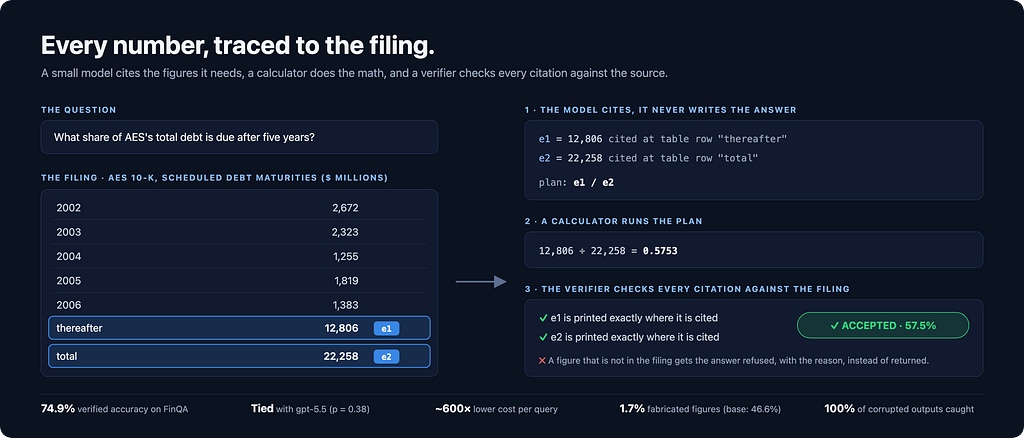
In financial analysis, an AI-generated number is functionally useless if it cannot be verified against an official filing. When language models calculate ratios or pull metrics from corporate 10-K reports, they frequently slip digits, grab figures from incorrect rows, or fabricate plausible figures entirely. Developer Govind Mudavadkar tackled this vulnerability by designing LedgerMind, an open system that strips the model of its ability to output final computed values, relying instead on structural pointers, deterministic calculation, and automated rule checking.
LedgerMind achieved a 74.9% verified accuracy on the FinQA benchmark using a 4-billion-parameter model (Qwen3-4B) running on a single GPU. Before training, the base model answered just 20.4% correctly. In paired testing on identical questions, LedgerMind ended in a statistical tie with OpenAI’s gpt-5.5 (p = 0.38) while lowering query costs by approximately 600 times—running at about $0.022 per 1,000 queries compared to $12.90 for gpt-5.5.
Decoupling extraction, calculation, and verification
Traditional language models struggle with multi-step arithmetic and table reasoning because they generate text sequentially without external validation. LedgerMind addresses this by partitioning the workflow into three discrete components: proposal, computation, and verification.
The model's role is restricted strictly to reading tables and planning. Instead of generating a final answer, it outputs structured data identifying the exact row, column, and value from the corporate filing alongside an algebraic formula (such as dividing one cell ID by another). A deterministic engine executes the formula, ensuring arithmetic consistency every time.
Before any answer is returned, a non-AI verifier checks the result against four programmatic gates:
- Provenance: Confirms that cited figures exist at the exact table coordinates reported by the model, preventing fabricated figures, misaligned years, and scale discrepancies.
- Plan hygiene: Ensures the mathematical formula actually depends on the cited evidence and prevents smuggled constants.
- Invariants: Validates that units, scales, and reporting periods align properly, avoiding errors like adding percentages to raw dollar amounts.
- Integrity: Verifies that row items match printed table totals, alerting the pipeline if source documents were modified.
If any gate fails, the system returns a structured refusal with the reason rather than guessing an answer.
Training on a single GPU with verifiable rewards
The training process was completed in two stages on a single NVIDIA H200 GPU using the open FinQA dataset of 8,281 expert-written questions over S&P 500 annual filings.
In stage one, supervised fine-tuning (SFT) with a LoRA adapter taught Qwen3-4B the target schema over two epochs in 67 minutes. This lifted valid schema output to 99.9% without constrained decoding and raised verified accuracy to 74.5%.
In stage two, reinforcement learning was applied using Group Relative Policy Optimization (GRPO). Instead of relying on a human-preference reward model, LedgerMind utilized the programmatic verifier itself as the reward signal—an approach known as reinforcement learning from verifiable rewards (RLVR). By filtering for questions the model solved only some of the time and penalizing extraneous citations or disconnected formulas, sampled accuracy rose 7.1 points.
To test reliability, Mudavadkar ran adversarial tests using a framework called the Saboteur. The verifier caught 100% of 7,212 deliberately corrupted answers, and flagged modified figures in tampered documents between 99.7% and 100% of the time. When served using vLLM with fp8 quantization on an H200, the pipeline sustained 48.7 requests per second at roughly half a second per query.
What it means for developers
LedgerMind illustrates a practical architectural path for developers working in audit, compliance, investment research, and banking, where unverified outputs are unacceptable. By constraining small models to structured extraction and offloading arithmetic to deterministic code, teams can deploy audit-ready automation inside their own infrastructure without leaking sensitive documents to external APIs.
The project also highlights the boundaries of verification. Even with deterministic checks, 254 of the 1,107 accepted test answers were incorrect, primarily because the model cited the wrong row or year—a mistake the verifier cannot catch if the referenced numbers exist. However, because every output includes precise cell coordinates, human reviewers can validate or reject an answer in seconds rather than recalculating the filing manually.
For engineering teams comparing model architectures across different deployment patterns, testing reasoning performance remains essential. Developers can try top AI models cheaply through one API at https://apixoai.online to baseline proprietary options against open, fine-tuned alternatives before committing to custom pipeline development.
Source: I Built a Finance AI That Proves Every Number It Gives You — Towards AI. Written by the Apixo team from that report.
One key for Claude, GPT, GLM, DeepSeek and more. Pay per token with crypto.
Get your API key